Spirits glass · Vodka and spirits bottles
A clear spirit is judged by its bottle. Super flint, a heavy base, and one profile across the ladder.
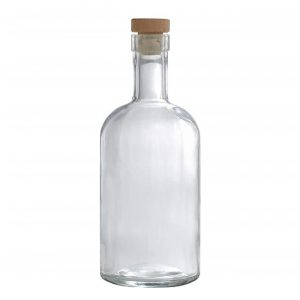
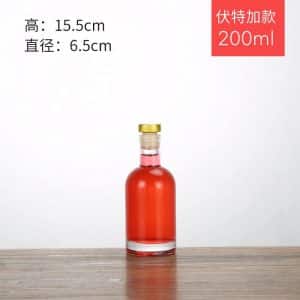
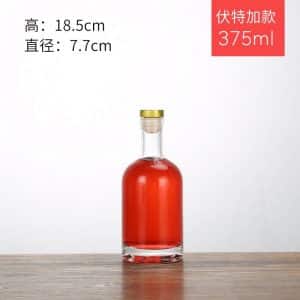
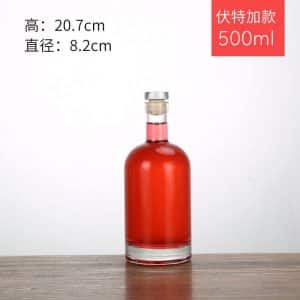
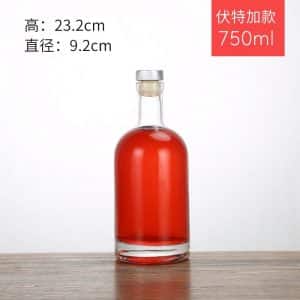
Your customer judges a clear spirit by its bottle, and the super flint here comes out of our Shandong furnaces in Shandong. One Oslo profile gives you five sizes from 200 ml to 1 litre (7 to 34 fl oz), on a cork or a screw finish. Heights and diameters sit on every card, so your carton and your shelf are settled before you send an enquiry.
One silhouette across the ladder, with the height and diameter of each size on its card. Sharing a profile lets your 200 ml sampler and your litre sit together on a back bar. We quote wholesale per size, cork or screw priced beside it.


That size does not run on the Oslo body. Your quotation can still cover it: the same finish appears on our gin and liquor ranges.

A clear spirit hides nothing, so the glass carries the whole impression. Three things reach you in writing before a deposit.
What is at stake
Vodka is colourless and, on a shelf, largely indistinguishable. Your customer picks a bottle up, and what they judge is clarity, weight and how the base feels in the hand. A thin bottle in ordinary flint reads as a cheap spirit before your customer has tasted anything.
What we supply
Every size you order is super flint, the highest-clarity melt we run, on the Oslo body with a thick heavy base. Your quotation states the glass weight per size, because that number is both what you pay for and what your customer feels when they lift it.
What has to match
Your standard is 700 ml across the EU and UK and 750 ml in the United States. They are different bottles, and ordering the wrong one leaves you with glass that cannot carry your label in the market you sell into.
What we supply
This Oslo ladder runs 200, 375, 500, 750 and 1000 ml, so it is built for the US standard and for your duty-free listing. Where you need 700 ml for Europe, say so with the enquiry and it is quoted on a separate body rather than assumed into this one.
What is at stake
A T-top cork suits a craft spirit and reads as premium, and it needs a corker and a hand or semi-automatic line at your end. A screw finish suits volume and a capper. Choose the closure after the glass and you end up hand-finishing a pallet.
What we supply
Both finishes run on this body, and every design ships its finish drawing with your quotation. Corks, T-tops and screw caps are all quoted with the glass, so your line and your closure arrive matched.
Two closure systems run against this profile, and your quotation prices the closure and the capsule beside the glass.
Your quotation states the finish, the closure and the capsule, so your distillery or your contract bottler signs off before glass is committed.
Bulk terms from the super-flint plant. No tooling on a running body, 15–20 days from confirmation, corked samples in your hand, and a pallet count printed beside your price.
Pallet or container
A running mould carries no tooling minimum, so your first run can be a single pallet, on identical terms for private-label brands and contract bottlers. A mould of your own in extra flint starts at 12,000 pieces, which spirits reaches sooner than most because the bottle carries the brand.
15–20 days
From confirmation on running moulds, glass and closures together. A custom mould adds 30–45 days to your lead time, counted from drawing approval.
On request
Bottles go out with the closure, so you can weigh one in the hand and your bottler can run a corking or capping trial before committing a batch. On the custom path, an acrylic model lands in about 10 days at $500, then a sample mould at 35 days puts 5–10 bottles on your desk.
EXW · FOB
Warehousing and consolidation stay in-house, and we quote transit to your port. Your spirits bottles travel with wine or dessert bottles in one container, which is how most opening orders ship.
Per size, with the quote
Heavy-based spirits glass weighs more per bottle than most drinks glass, so you hit the pallet weight limit before you fill the volume. Your quotation gives carton dimensions and 20GP and 40HC counts per size.

You win a vodka shelf on finish, and finish happens on glass that is already tooled. Our Shandong plant frosts, sprays, screen prints, hot stamps, electroplates and labels in-house, so your decorated glass keeps the same 15–20 days as plain.
We quote decoration per design, beside the glass. Decoration and labelling in detail →

A drawing, a rival's bottle or a rendering starts the check. The Oslo ladder carries your first release well, and vodka is the category where a brand that finds its market cuts steel soonest. Our mould shop prices that path in three stages.
A full-size model of your bottle, so you sign off shape, shoulder, base weight and label panel before steel is cut.
Real glass from a sample mould: 5–10 bottles for your bottler and your buyer to weigh, fill and approve.
Your production tooling runs on the flint lines in Shandong. Minimum 12,000 pieces in extra-flint, 50,000 in standard flint.

We melt super flint in Shandong, where 7 lines turn out 600,000 pieces a day, and a clear spirit shows every fault the melt makes. Your bottles are annealed, inspected and packed inside the group, and spirits brands in 40+ countries have shipped from these Shandong lines since 2013.
We check the super flint melt against a retained reference. On a colourless spirit any cast in the glass becomes a cast in the product, and your customer reads it as the liquid rather than the bottle.
Weight checked against the drawing across the run, because it is both the price you agreed and the heft your customer judges the spirit by.
We gauge the cork bore and the screw finish on every run. A bore a fraction wide gives you a T-top that creeps out in a warm warehouse.
Your shipment carries an EC 1935/2004 declaration of compliance for the EU and UK, food-contact documentation to FDA requirements for the United States, and ISO 9001. SGS test reports and third-party pre-shipment inspection come on request.
700 or 750, height, base weight and cork, so your carton and your shelf are settled first.
Not on this Oslo ladder, which runs 200, 375, 500, 750 and 1000 ml and is built around the US standard and your duty-free listing. 700 ml is the EU and UK standard and a different bottle, so tell us the market with your enquiry and it gets quoted on the right body instead of assumed onto this one.
23.2 cm and 9.2 cm across on the Oslo body. The ladder runs 15.5 cm at 200 ml, 18.5 cm at 375 ml and 20.7 cm at 500 ml, which is enough to size a gift box or a shelf before you order.
Base weight is the first thing your customer feels, and the mould and the gob weight set it, not anything done in finishing. The Oslo bodies here run a heavy base as standard, and the glass weight per size comes with your quotation so you can lay it against the bottle you fill today. A heavier base than that is a mould of your own at 12,000 pieces in extra flint.
The glassworks. We melt the super flint at our own Shandong plant, one of MAIDAO INDUSTRY's two production sites, and SGSBOTTLE is the export brand that quotes and ships it to you. A broker places your order somewhere you never see and adds a margin that never appears on the invoice.
Because there is nothing else to look at. A clear spirit shows every cast in the glass as if it were in the liquid, and the shopper who picks up your bottle is judging clarity and weight before contents. Super flint is the highest-clarity melt we run.
A T-top cork reseals and reads as craft, and it needs a corker on your line. A screw finish suits volume and travel retail and removes cork variability. Both run on this body, and the finish drawing goes out with your quotation so your line is checked first.
There is no tooling minimum on the running-mould sizes, so your first run can be a single pallet. A mould of your own in extra flint starts at 12,000 pieces, which spirits reaches sooner than most because the bottle carries the brand.
Yes, and in spirits that is the usual answer, not the exception. Your acrylic model takes about 10 days at $500, a sample mould 35 days at around $1,200, and production tooling $1,200 to $2,200 against a 12,000-piece minimum in extra flint.
Yes. Your order ships with food-contact documentation to FDA requirements for the United States and an EC 1935/2004 declaration of compliance for the EU and UK, and SGS test reports come on request.
By weight before volume, which is the opposite of most drinks glass. A heavy-based bottle hits the pallet weight limit while the container still has room, so your quotation gives carton dimensions and per-size counts, not a headline figure.
A size, a market or the bottle you fill today is enough to start. Our spirits desk answers with pricing, heights and loading data inside 24 hours.
Matching running-mould bottles, heights and loading data come back within 24 hours.
The tooling path is quoted by stage before anything is committed.