
Every other finish in glass packaging has a number. Your swing top has a shape instead. That single difference changes how you specify it, how you source the closure, and what can go wrong on your line.
The 2 Parts of Your Swing-Top Seal
Your glass carries the load. The mould forms a ring into the neck, and your wire bail hooks under it. When the lever closes, the bail pulls your stopper down and the neck ring takes the whole force. Nothing about that is threaded, so nothing about it is interchangeable by designation.
Your gasket makes the seal. A rubber or silicone ring 3 mm wide on the face of your stopper presses against the sealing surface, and the flatness of that ring of glass decides whether your seal is even. On a wide-mouth clip-top jar the same principle applies with a glass lid, and ISO 9885 covers how flat the sealing surface has to be.
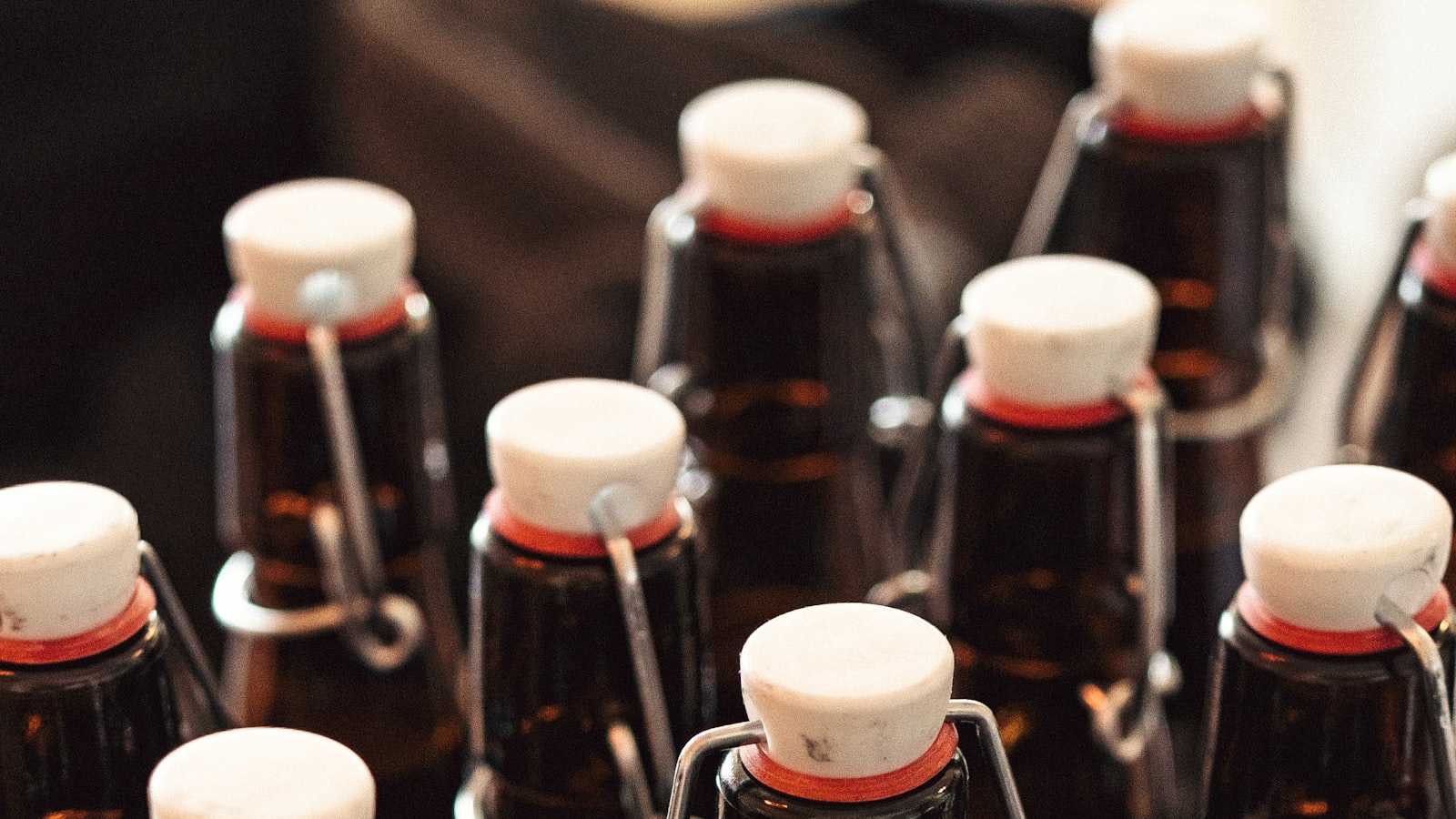 Your glass carries the load and your gasket makes the seal, and only one of the two is replaceable.
What Your Drawing Has to Carry
| Figure | Why it matters |
|---|---|
| Ring diameter. | Your bail hooks under it, and a few tenths of a millimetre change the closing force. |
| Ring height from the sealing surface. | Sets how far the lever travels and how hard the gasket is compressed. |
| Sealing surface width and flatness. | Your gasket presses here, and a dip in the ring is a slow vent. |
| Bore. | What your filling nozzle passes, and what the stopper body clears. |
| Wall and base distribution. | Where the pressure rating comes from on a carbonated fill. |
SGSBOTTLE forms swing-top necks in Shandong and at Xuzhou, 7 lines at each. Cetie publishes GME 12.10 for the swing stopper finish, and beyond that your bail supplier works from your bottle drawing. A physical bottle with a physical bail is your only complete test, and the free sample stage exists for it.
Pressure Belongs to Your Bottle
Your swing top turns up on two very different products. A 330 ml (11 oz) beer, cider or kombucha bottle is designed to hold pressure, with the wall and base to match, and ISO 7458 measures its internal pressure resistance. A decorative swing top for oil, syrup or still water is a closure style on a bottle nobody pressure-tested.
The two look alike on a photograph and behave nothing alike after your second fermentation. Naming your fill and its carbonation on the enquiry separates them, and the strength-test guide covers the methods and the benchmarks the trade quotes.
Reuse: Your Gasket Is the Part That Wears
The format sells on reuse, and your gasket is the part that wears. It hardens, it takes a compression set, and it eventually vents. A returnable programme therefore budgets replacement gaskets, and the compound gets specified with the fill: an oily product, a hot fill and a fermented drink each ask something different of the same rubber.
Everything else survives for you. Your bail is stainless or plated wire, your ceramic or plastic stopper outlasts the gasket, and your glass outlasts both when nothing has scratched it. SGSBOTTLE runs swing-top bottles and clip-top jars from 100 ml to 2 L (3.4 to 68 oz) on 14 lines across two sites in Shandong and Xuzhou.
What Goes on Your Enquiry
The bail assembly you already buy or a sample of it, the fill and its carbonation, the format in ml and oz, and whether the pack is one-trip or returnable. SGSBOTTLE engineers return the designs whose neck ring that assembly fits, with the drawing attached and a pressure figure where your fill needs one.