Every quote answered within 24 hours  ·  Mon–Sat 8:30–18:00 (GMT+8)  ·  sales@sgsbottle.com
Quality control lab technicians inspecting and measuring glass bottles

Glass Packaging Resources for Bottle and Jar Buyers

Guides, reference tables and the paperwork a first order turns on, from SGSBOTTLE, the MAIDAO INDUSTRY brand forming 700 million bottles a year on 14 lines in Shandong and Xuzhou. Your quotation carries the finish drawing and the loading plan; everything else a buying team asks a glass factory for lives in one library.

Certificates and test reports →
14Production lines
700MBottles a year
40+Export markets
27Stock categories

Your First Glass Order in 6 Steps

The decisions a first container turns on, in the order a buying team meets them, with the numbers each one needs.

01

Category and capacity

You choose from 27 stock categories and 10,000+ SKUs, 3 ml to 8 L (0.1 to 270 oz), on moulds that are already running. A first order can be a single pallet.

Browse the catalogue →
02

Glass grade and colour

Standard flint runs from 50,000 pieces on a custom mould, extra-flint from 12,000. The grade you specify decides which site forms your bottle and where your minimum sits.

Flint vs extra-flint →
03

Finish and closure

Your cap decides the jar. The finish drawing comes with every quotation, so your closure supplier confirms the match on paper before you commit a container to it.

Match a cap to a finish →
04

Stock mould or custom mould

An acrylic prototype at $500 in about 10 days, a sample mould at $1,200 in 35 days, production tooling at $1,200–2,200. Some shapes let you skip the sample mould altogether.

Stock mould or custom mould →
05

Samples and inspection

Stock samples are free, and decorated samples come off the sample mould for sign-off. Every bottle gets a finish inspection at all two sites; a polariscope strain report joins your batch on request.

What a third-party inspection checks →
06

Container and paperwork

About 25,000 bottles of 750 ml (25 oz) fill a 40HC in standard shapes. The loading plan for your cartons comes with the quote, with the certificates your customs broker and retailer ask for.

Container loading maths →

Six Pillars of Glass Packaging Knowledge

Every guide, reference table and checklist files under one of the six questions a glass order raises.

Pillar 03

Decoration & Branding

Frosting, spray coating, screen printing, hot stamping, electroplating and labelling on glass, and what each process asks of your artwork, your minimum and your budget.

Pillar 04

Custom Mould Development

From drawing to production glass mould in three priced stages, $500 acrylic, $1,200 sample mould and $1,200–2,200 production tooling, and the minimums that follow.

Pillar 06

Logistics & Landed Cost

How many glass bottles fill a 40HC, what bulk and palletised loading each cost you, and what moves the price between EXW and your warehouse door.

Guides and Reference Tables for Glass Bottle Buyers

Long-form answers with the numbers attached, each one reviewed against the figures our two sites actually run to. Start from your own question: your format, your closure, your market or your freight. Every guide closes with what your enquiry should carry, so your first message to us is one we can quote against.

Glass Packaging 101

How a bottle takes shape, what flint, extra-flint and amber glass actually are, and the vocabulary your quotation and finish drawing are written in.

Reference

Glass Packaging Glossary: 91 Terms Every Bottle Buyer Meets

Ninety-one glass packaging terms, annealing to twist-off, each with what it costs you when it goes wrong, from SGSBOTTLE's 14 lines in Shandong and Xuzhou.

15 min read · Reviewed September 6, 2026.
Guide

How Glass Bottles Are Made: 8 Steps From Batch to Pallet

From sand and cullet to a palletised container: the eight steps a glass bottle takes at SGSBOTTLE's two sites in China, and what each one decides for your order.

5 min read · Reviewed September 6, 2026.
Guide

Flint vs Extra-Flint Glass: Clarity, Colour and MOQ in 2026

Standard flint or extra-flint (super-flint) for your bottle: where the green tint shows, which fills need water-white glass, and the MOQ behind each grade.

4 min read · Reviewed September 6, 2026.
Guide

Glass vs PET: 6 Factors That Decide Your Packaging

Barrier, weight, shelf life, freight, recycling and shelf presence, compared for your fill. Where glass earns its cost, and where PET is the honest answer.

3 min read · Reviewed September 7, 2026.
Guide

Glass vs Aluminium Cans: 6 Trade-Offs for Your Brand

Cans win on weight, chill speed and breakage; glass wins on shelf presence, reseal and taste neutrality. Where each earns its place in your range.

3 min read · Reviewed September 7, 2026.
Guide

Amber, Green or Clear Glass: What 3 Colours Block

Glass colour is a furnace decision with an optical job. What amber, green, flint and extra-flint block, and how far a sprayed colour protects.

3 min read · Reviewed September 7, 2026.
Guide

Soda-Lime vs Borosilicate: 4 Differences That Matter

Borosilicate takes more thermal shock and costs more to melt. Where the difference is real, where it is oversold, and what container glass actually uses.

3 min read · Reviewed September 7, 2026.
Guide

Glass Batch: 5 Raw Materials and What Each One Does

Sand, soda ash, limestone, cullet and the minor additions. What each contributes to your bottle, and why the batch decides colour and grade before forming.

3 min read · Reviewed September 7, 2026.
Guide

Cullet: How 30% Recycled Glass Changes Your Melt

Cullet is crushed recycled glass fed back into the furnace. What it does to energy, quality and your recycled-content claim, and why colour separation limits it.

3 min read · Reviewed September 7, 2026.
Guide

Glass Furnaces: How 2 Sites Decide Your Colour

A container furnace melts one colour continuously for years. What a campaign is, how furnace scheduling reaches your quotation, and why 2 colours cost more than 1.

3 min read · Reviewed September 7, 2026.
Guide

The Gob and the Feeder: Where 1 Setting Fixes Weight

Molten glass is cut into gobs before forming, and gob weight becomes bottle weight. How the feeder works, and why your freight bill starts here.

2 min read · Reviewed September 7, 2026.
Guide

The IS Machine: 6, 8 or More Sections Making Your Bottle

The individual section machine forms nearly every glass container. How a section works, what sets line speed, and what it means when a quotation names 6S or 8S.

3 min read · Reviewed September 7, 2026.
Guide

Blow-and-Blow Forming: The 2-Stage Narrow-Neck Process

Compressed air settles the gob and blows the parison, then blows it again to shape. How the oldest forming process works and where it still beats the alternative.

3 min read · Reviewed September 7, 2026.
Guide

Press-and-Blow and NNPB: 2 Ways to Lighten a Bottle

A plunger spreads glass more evenly than air. How press-and-blow works, what NNPB added, and how much weight your bottle can lose without losing strength.

2 min read · Reviewed September 7, 2026.
Guide

Parison and Wall Distribution: 4 Places Glass Runs Thin

The parison decides where your glass ends up. How thickness is set before the blow mould, why thin spots cluster in the same 4 places, and what you can ask for.

3 min read · Reviewed September 7, 2026.
Guide

Glass Mould Construction: The 4 Parts and Where Seams Fall

A bottle mould is a set, not one block. What the blank, blow, neck ring and baffle each do, and why your seam lines land exactly where they land.

3 min read · Reviewed September 7, 2026.
Guide

Hot-End Coating: The 1 Layer That Keeps Bottles Strong

Tin oxide is applied seconds after forming, before the lehr. What hot-end coating does to your glass surface, why it comes first, and how the thickness is checked.

2 min read · Reviewed September 7, 2026.
Guide

Cold-End Coating: Why 1 Scratch Costs Strength for Good

The second coating goes on after the lehr and makes bottles slide instead of scrape. What lubricity buys you, how it is tested, and where it interferes with labels.

2 min read · Reviewed September 7, 2026.
Guide

Glass Colour Chemistry: What 4 Metals Do to Your Light

Colour in glass comes from metal ions in the melt, not from a coating. What iron, chromium, cobalt and the sulphur-carbon amber system each block, and what that protects.

3 min read · Reviewed September 7, 2026.
Reference

Bottle and Jar Size Chart: oz to ml Across 11 Formats

One fluid ounce means two different volumes. A conversion chart for every trade size, both ounce systems side by side, and the rounding conventions the trade uses.

2 min read · Reviewed September 7, 2026.
Reference

8 oz in ml: 237 ml, and Why the UK Number Is 227

Eight ounces is 236.6 ml in the US and 227.3 ml in imperial measure. Where the 8 oz jar sits in the trade, and the mistake that ships the wrong size.

2 min read · Reviewed September 7, 2026.
Reference

750 ml in oz: 25.4 US Ounces and 26.4 Imperial

The wine and spirits standard converts to an awkward number in both ounce systems. Why 750 ml became the global format, and what it means for your bottle and your pallet.

2 min read · Reviewed September 7, 2026.
Reference

12 oz or 355 ml? The North American Beverage Size

12 US fluid ounces is 354.88 ml, sold as 355 ml. Why this size dominates North American drinks, how it compares with 330 ml, and what it does to your container count.

2 min read · Reviewed September 7, 2026.
Guide

Nominal, Brimful and Fill Point: 3 Volumes, One Bottle

Brimful, nominal and fill point are three volumes and only one reaches your carton. What each means, which one your filler needs, and where the confusion costs a run.

2 min read · Reviewed September 7, 2026.
Reference

16 oz in ml: 473 ml, and Why a Pint Has 2 Sizes

16 US fluid ounces is 473.18 ml, but an imperial pint is 568 ml. What that gap does to your specification, and where the 16 oz format sits in the trade.

2 min read · Reviewed September 7, 2026.
Reference

1 Litre in oz: 33.8 US Ounces and Where It Is Used

A litre is 33.81 US fluid ounces and 35.20 imperial ones. Where the 1 L format is a legal standard, where it competes with 750 ml, and what it does to your pallet.

2 min read · Reviewed September 7, 2026.
Reference

250 ml in oz: 8.5 Ounces, and Not an 8 oz Jar

250 ml is 8.45 US fluid ounces, so it is not the 8 oz trade size. Where the 250 ml format is a standard in its own right, and what the difference does to your fill.

2 min read · Reviewed September 7, 2026.
Guide

Headspace: The 4 Jobs That Empty Volume Is Doing

Headspace is not wasted volume, it is working volume. What your closure, your product and your process each need from it, and what happens when you take it away.

2 min read · Reviewed September 7, 2026.
Guide

Hot Fill, Cold Fill and Aseptic: 3 Routes for Glass

Your filling method decides your headspace, your closure and your thermal shock margin. What each of the three routes asks of a glass bottle, and where each one fails.

2 min read · Reviewed September 7, 2026.
Guide

Pasteurisation and Glass: Tunnel, Batch and 3 Limits

A pasteuriser heats and cools your filled pack in stages, and glass has limits at every stage. How tunnel and batch differ, and what the differential does to your bottle.

2 min read · Reviewed September 7, 2026.
Guide

Nitrogen Dosing: 3 Things a Gas Headspace Buys You

A drop of liquid nitrogen displaces oxygen and stiffens a bottle. How dosing works, what it does for shelf life and lightweighting, and where it goes wrong on glass.

2 min read · Reviewed September 7, 2026.
Guide

Capping Heads: 3 Types and Why Glass Jams a Line

The capping head that applies your closure decides how repeatable your seal is. How chuck, magnetic and servo heads differ, and what a format changeover really involves.

2 min read · Reviewed September 7, 2026.
Guide

Line Speed and Glass Handling: 4 Places Bottles Get Hurt

A faster line scuffs, jams and breaks more glass. Where the damage happens, what coating and wall distribution do about it, and how to find your real speed ceiling.

2 min read · Reviewed September 7, 2026.
Guide

Labelling Machinery: 3 Systems and What Each Needs

Your labeller decides what your bottle has to give it. How wet glue, pressure sensitive and shrink sleeve machines differ, and which bottle geometry each one demands.

2 min read · Reviewed September 7, 2026.
Guide

Line Changeover Between Formats: 6 Things That Change

Switching bottle format is a job, not a dial. What changes at the conveyor, filler, capper and labeller, and how bottle choices cut your changeover time for years.

2 min read · Reviewed September 7, 2026.
All Glass Packaging 101 guides →

Specs & Compatibility

Finish designations, capacity and weight tolerances, and whether the glass bottle you shortlist runs on the filling line and capping head you already own.

Reference

Glass Neck Finish Library: 400, 410, 415, Lug, Crown, BVS

Every neck finish a glass buyer meets, from GPI 24-410 to BVS 30×60 and the 26 H 180 crown, with the published T, E, I, H and S figures and the closure each one takes.

13 min read · Reviewed September 6, 2026.
Reference

43-485 Finish: The Spice Jar Neck a 43-400 Cap Will Not Fit

The 43-485 finish is the US spice-jar standard for sifter, shaker and flip-top caps. What it is, how it differs from 43-400, and the jars that carry it.

3 min read · Reviewed September 7, 2026.
Reference

Lug Twist-Off Finishes: 38 to 110 mm, Regular and Deep

The vacuum lug finishes of ISO 9100, from 38 mm to 110 mm: which size suits your jar, what regular and deep change, and how you order a twist-off cap.

3 min read · Reviewed September 7, 2026.
Reference

26 H 180 Crown Finish: Dimensions, Bore and Cap Fit

The tall 26 mm crown finish of ISO 12821: its bore, its crimping edge, how it differs from the shallow 26 H 126, and what your crown capper needs from the glass.

3 min read · Reviewed September 7, 2026.
Reference

BVS 30x60 Wine Screw Finish: All 9 Dimensions and Tolerances

The BVS 30x60 screw finish for wine and spirits, dimension by dimension: thread, seal and locking-ring diameters, heights, bore and the ovality your capper needs.

3 min read · Reviewed September 7, 2026.
Reference

FEA 15, 18 and 20: Perfume Crimp Necks and Pump Fit

FEA names the collar your fragrance pump crimps onto. What 13, 15, 17, 18 and 20 mean, crimp against screw, and the figures your pump supplier asks for first.

3 min read · Reviewed September 7, 2026.
Reference

70-450G and 86-450G: The 2 Mason Jar Finishes

Regular mouth is 70-450G and wide mouth is 86-450G. What the 450 series does, why the G matters on glass, and which two-piece lids fit your jars.

3 min read · Reviewed September 7, 2026.
Reference

38-400 Finish: 1 Thread Turn, and 6 Packs That Use It

38-400 is the most widely stocked wide-neck finish in food and beverage. What it carries, how it differs from 38 mm lug and DBJ necks, and which caps fit yours.

3 min read · Reviewed September 7, 2026.
Reference

28-400 or 28-410? 1 Thread Turn Against 1 and a Half

28-400 and 28-410 are two different bottles. The published T, E, I, H and S figures for each, what the extra half turn buys, and why the caps never interchange.

2 min read · Reviewed September 7, 2026.
Reference

24-410 Finish: The Pump Neck on 2 to 8 oz Bottles

24-410 carries most lotion pumps, foamers and sprayers. Its published dimensions, what one and a half thread turns buy, and how to match a pump you already stock.

3 min read · Reviewed September 7, 2026.
Reference

Glass Bottle Capacity and Tolerances: 7 Figures to Check

Nominal against brimful capacity, fill point, weight, verticality and finish flatness: seven figures on a glass bottle drawing, and the ISO standards behind them.

5 min read · Reviewed September 6, 2026.
Reference

Dropper Finishes: 18-400, 18-415 and the European DIN 18

Three 18 mm necks take three different dropper caps. What separates the 400, 415 and DIN 18 finishes, and which one your pipette and tamper band were made for.

2 min read · Reviewed September 7, 2026.
Reference

Bar-Top Cork Finishes: 27, 29, 34 mm and an 18.5 mm Bore

Bar-top stoppers, cork mouths and the bores behind them: the Cetie and EN standards, what pull force depends on, and how a spirits neck is specified.

3 min read · Reviewed September 7, 2026.
Reference

Swing-Top and Clip-Top Necks: 2 Parts Carry Your Seal

A swing top has no thread and no series number. What the neck ring does, what the gasket does, and how a reusable bottle or jar is actually specified.

3 min read · Reviewed September 7, 2026.
Checklist

Closure Compatibility: 9 Checks Before You Order Glass

Nine checks that keep a cap from leaking on your line: finish designation and drawing, sealing surface and liner, torque, tamper band, fill and sample run.

5 min read · Reviewed September 6, 2026.
Guide

Lug vs Continuous Thread: 2 Ways to Close Your Jar

A lug cap holds a vacuum in a quarter turn; a continuous thread seals on a liner. What each asks of your fill, your line and your consumer.

3 min read · Reviewed September 7, 2026.
Guide

Cork, ROPP or Crown: 3 Ways to Close Your Bottle

Cork, ROPP and crown are three different bottles. What each seals against, which capping head it needs, and where reseal, pressure and presentation decide.

3 min read · Reviewed September 7, 2026.
Guide

Swing Top vs Crown Cap: 3 Ways They Differ

Two ways to close a pressurised bottle. What a bail and gasket give you that a crimped crown cannot, and what they cost in speed and consistency.

3 min read · Reviewed September 7, 2026.
Reference

Closure Liners: 5 Materials and What Each One Seals

The cap holds the liner; the liner holds the seal. What pulp, foam, plastisol, foil and EPE each do, which fills they suit, and how to put one on your specification.

3 min read · Reviewed September 7, 2026.
Guide

Application and Removal Torque: The 3 Numbers to Hold

Torque is where a good cap and a good bottle still fail. What application and removal torque mean, why the number decays after capping, and how to set your window.

2 min read · Reviewed September 7, 2026.
Reference

Tamper Evidence: 4 Systems and What Each One Proves

Tamper evidence has to show interference, not prevent it. How bands, shrink sleeves, induction seals and lug buttons work, and which one your market expects.

2 min read · Reviewed September 7, 2026.
Guide

How a Vacuum Seal Forms: 4 Steps and What Breaks It

A vacuum jar seals as it cools, not as it closes. What creates the pressure difference, why the button pops, and the handling mistakes that lose your seal.

2 min read · Reviewed September 7, 2026.
Guide

Induction Sealing on Glass: How the Foil Bonds in 1 Pass

An induction head welds a foil membrane to your bottle in under a second. How the field heats the foil, what the sealing surface must give it, and why seals fail.

2 min read · Reviewed September 7, 2026.
Guide

Child-Resistant Closures: 3 Mechanisms and the Standards

A child-resistant cap has to defeat a toddler and still open for an adult. How push-and-turn, squeeze-and-turn and snap-lock work, and what the test protocols measure.

2 min read · Reviewed September 7, 2026.
Reference

Pumps, Sprayers and Droppers: 4 Mechanisms Explained

A dispensing closure is a small machine on your bottle. How lotion pumps, fine-mist sprayers, droppers and trigger heads work, and what each needs from the glass.

2 min read · Reviewed September 7, 2026.
Reference

Gaskets and Sealing Compounds: 4 Materials by Fill

A gasket is chosen by chemistry and temperature, not by looks. What silicone, EPDM, natural rubber and cured plastisol each survive, and where they fail on glass.

2 min read · Reviewed September 7, 2026.
Tool

ml to oz Converter: Both Systems and 15 Trade Formats

Convert a bottle volume between millilitres and both fluid ounces, and see the nearest trade format. The full conversion table renders whether the converter runs or not.

2 min read · Reviewed September 7, 2026.
Tool

Neck Finish Finder: Match a Cap to a Finish in 2 Filters

Filter the common finish designations by the closure you hold or the diameter stamped on it. The full table renders whether the filter runs or not.

2 min read · Reviewed September 7, 2026.
Tool

Mould Cost Estimator: 3 Stages by Cavity Count

Add the prototype, sample mould and production tooling for a cavity count you choose. The published stage prices render whether the estimator runs or not.

2 min read · Reviewed September 7, 2026.
All Specs & Compatibility guides →

Decoration & Branding

Frosting, spray coating, screen printing, hot stamping, electroplating and labelling on glass, and what each process asks of your artwork, your minimum and your budget.

Guide

Glass Bottle Decoration Guide: 7 Processes, One Comparison

Frosting, spray coating, screen printing, decals, hot stamping, electroplating and labelling on glass bottles: what each survives and what it asks of your artwork.

9 min read · Reviewed September 6, 2026.
Guide

Fired Print vs Label: 5 Ways They Differ on Glass

A fired ceramic print is part of the glass; a label sits on it. Durability, cost, colour, minimums and lead time compared for your decoration decision.

3 min read · Reviewed September 7, 2026.
Guide

Embossing on Glass: What a Mould Can Hold at 1 mm

Raised lettering is cut into steel, not printed. How embossing depth, radius and draft work, what glass will and will not fill, and how to keep your logo legible.

3 min read · Reviewed September 7, 2026.
Guide

Frosting Glass: 3 Methods, Bands and Gradients

Frosting is a surface change, not a coating. How acid etching, sandblasting and frost coatings differ, what each does to fingerprints, and which suits your artwork.

2 min read · Reviewed September 7, 2026.
Guide

Spray Coating Glass: 4 Things Coloured Glass Cannot Do

Spray coating puts colour on the outside of a finished bottle. How the layer goes on and cures, what it survives, and why it beats coloured glass on small runs.

2 min read · Reviewed September 7, 2026.
Guide

Screen Printing on Glass: Ceramic Ink and 4 Artwork Rules

Screen printing pushes ceramic ink through a mesh and fires it into the glass. How the passes work, what registration costs, and the artwork rules that decide the result.

2 min read · Reviewed September 7, 2026.
Guide

Decals on Glass: The 4 Steps a Screen Cannot Match

A decal carries photographic artwork onto a bottle and fires it into the glass. How the transfer works, what it costs against screen printing, and when your art needs it.

2 min read · Reviewed September 7, 2026.
Guide

Hot Stamping Glass: Foil, Dies and the 3 Panel Rules

Hot stamping presses metallic foil onto glass with a heated die. What it can and cannot reproduce, why the panel matters, and how it compares with a fired print.

2 min read · Reviewed September 7, 2026.
Guide

Electroplating Glass: How the Metal Layer Bonds in 3 Stages

Metallised glass looks like solid metal and weighs nothing extra. How vacuum metallising and electroplating differ, what the layer survives, and where it fails.

2 min read · Reviewed September 7, 2026.
Guide

Labelling Glass: 3 Adhesive Systems and Surface Energy

Most label failures are surface failures. How wet glue, pressure-sensitive film and shrink sleeves differ on glass, and why coatings change what your adhesive can do.

2 min read · Reviewed September 7, 2026.
Checklist

Artwork for Glass: 5 Checks Before You Send the File

Artwork made for print fails on glass for predictable reasons. Vector formats, Pantone on a curve, minimum line weight, seam clearance and how to mark a proof.

2 min read · Reviewed September 7, 2026.
All Decoration & Branding guides →

Custom Mould Development

From drawing to production glass mould in three priced stages, $500 acrylic, $1,200 sample mould and $1,200–2,200 production tooling, and the minimums that follow.

Guide

Custom Glass Bottle Timeline: 9 Steps From Sketch to Run

Nine steps of a custom glass bottle project, with cost and deliverable at each: drawing, $500 prototype, $1,200 sample mould, production tooling, first run, reorders.

7 min read · Reviewed September 6, 2026.
Guide

Stock Bottle or Custom Mould: 4 Cases That Need Steel

Tooling, minimums, lead time and shelf differentiation compared. What a custom mould actually buys, and the four cases where an existing mould cannot serve.

3 min read · Reviewed September 7, 2026.
Checklist

Bottle Drawings and 3D Files: 6 Things a Mould Shop Needs

A sketch is not a drawing and a render is not a model. What a glass mould shop needs in your file, which dimensions it must carry, and what happens when they are missing.

2 min read · Reviewed September 7, 2026.
Guide

The Acrylic Prototype: 4 Things It Proves in 10 Days

An acrylic model costs a fraction of a mould and answers the questions a drawing cannot. What a prototype settles, what it cannot tell you, and when to skip it.

2 min read · Reviewed September 7, 2026.
Guide

The Sample Mould: 5 Answers Only Real Glass Can Give

A sample mould makes real bottles before production tooling is cut. What it proves about weight, wall and fit, what it costs, and why buyers try to skip it.

2 min read · Reviewed September 7, 2026.
Guide

Glass Mould Cost: The 5 Things That Move the Price

Two bottles of the same size can differ several times over in tooling cost. What shape, cavity count, finish, embossing and glass grade each add to your mould quotation.

2 min read · Reviewed September 7, 2026.
Guide

Cavity Count and Output: How 1 Mould Sets Your Run Rate

One mould is one cavity, and cavities decide how fast your order can be made. How section count, cycle time and cavity count combine into a realistic delivery date.

2 min read · Reviewed September 7, 2026.
Guide

Mould Ownership, Exclusivity and NDA: 4 Terms to Settle

Paying for tooling and owning it are different things. What ownership, exclusivity, an NDA and a transfer clause each cover, and what to agree before steel is cut.

2 min read · Reviewed September 7, 2026.
Guide

Mould Maintenance and Wear: 4 Signs on Your Bottles

Tooling wears from the first cycle. Which part goes first, what wear looks like on the glass you receive, and how a maintenance schedule protects your specification.

2 min read · Reviewed September 7, 2026.
All Custom Mould Development guides →

Quality & Compliance

How each site inspects every glass bottle, what the six transit failure modes look like, and which certificate answers which customs or retailer request.

Guide

3 Glass Bottle Strength Tests: Pressure, Shock and Load

Internal pressure to ISO 7458, thermal shock to ISO 7459 and vertical load to ISO 8113: the methods, the figures the trade quotes, and how to write one into your order.

6 min read · Reviewed September 6, 2026.
Guide

Glass Bottle AQL Guide: 3 Defect Classes and the Sampling Maths

Critical, major and minor glass bottle defects, the AQL most buyers write into an order, the ISO 2859-1 sample sizes behind it, and what SGSBOTTLE checks before packing.

6 min read · Reviewed September 6, 2026.
Reference

6 Glass Packaging Certificates and Who Asks for Each

ISO 9001, the SGS FDA lead and cadmium report, EC 1935/2004, Proposition 65, RoHS and a CNAS report: what each glass packaging certificate covers, and what it does not.

5 min read · Reviewed September 6, 2026.
Guide

Annealing and the Lehr: The 3 Stages That Remove Stress

A bottle that cools too fast breaks for no visible reason. What your annealing lehr does, how residual stress is graded in polarised light, and what to ask a supplier.

3 min read · Reviewed September 7, 2026.
Guide

The Polariscope: Reading Residual Stress in 3 Steps

A polariscope turns invisible stress into colour. How the instrument works, what an annealing grade under ASTM C148 means, and how to read the number on your report.

2 min read · Reviewed September 7, 2026.
Guide

Thermal Shock: Why Glass Cracks and How 42 C Is Tested

Glass breaks from a temperature difference across its wall, not from heat itself. Where your process creates that gradient, how the test runs, and how to design it out.

2 min read · Reviewed September 7, 2026.
Guide

Internal Pressure Testing: ISO 7458 Method A and B

Carbonated fills push outward for the life of the pack. How the two ISO 7458 methods differ, what a burst figure tells you, and how to specify pressure resistance.

2 min read · Reviewed September 7, 2026.
Guide

Vertical Load Testing: ISO 8113 and 3 Pallet Forces

A bottle at the base of a pallet carries the whole stack. How ISO 8113 measures vertical load, where the force actually goes, and what your stacking plan implies.

2 min read · Reviewed September 7, 2026.
Guide

Inspection Levels and Switching Rules in ISO 2859-1

An AQL is only half a sampling plan. What inspection levels I, II and III change, how normal, tightened and reduced inspection switch, and what to write into your order.

2 min read · Reviewed September 7, 2026.
Guide

Third-Party Inspection: The 5 Things an Agency Checks

An inspection agency verifies what a factory reports. What SGS, TUV and Bureau Veritas actually do on a glass order, what they cannot cover, and how to brief one.

2 min read · Reviewed September 7, 2026.
Checklist

Auditing a Glass Factory: 24 Questions Worth Asking

A factory tour shows you what the host chooses. What to ask about furnaces, forming, the cold end, tooling and records, and which answers tell you the most.

2 min read · Reviewed September 7, 2026.
Guide

Food-Contact Testing for Glass: 3 Documents to Ask For

Glass is inert, and buyers still need paperwork. What lead and cadmium testing covers, what an EC 1935/2004 declaration says, and which document each market wants.

2 min read · Reviewed September 7, 2026.
Reference

Glass Packaging Rules in the US: 5 Documents to Hold

Glass is inert and US paperwork still exists. What FDA food contact, Proposition 65, net quantity labelling, TTB fill standards and state deposit laws each ask of you.

3 min read · Reviewed September 7, 2026.
Reference

Glass Packaging Rules in the EU: 5 Obligations to Cover

The EU regulates the material, the quantity and the waste. What EC 1935/2004, nominal quantities, the e-mark, packaging waste rules and EPR each ask of a glass buyer.

2 min read · Reviewed September 7, 2026.
Reference

Glass Packaging Rules in the UK: 4 Changes Since Brexit

UK rules started from EU law and have moved. What assimilated food-contact law, packaging EPR reporting, deposit schemes and weights legislation now ask of a glass buyer.

2 min read · Reviewed September 7, 2026.
Reference

Glass Packaging Rules in Canada: 4 Things on Every Label

Canada regulates labelling more tightly than the material. What bilingual labelling, metric net quantity, food-contact review and provincial stewardship each require.

2 min read · Reviewed September 7, 2026.
Reference

Glass Packaging Rules in Australia: 4 Systems to Satisfy

Australia runs food standards, trade measurement, a recycling label and state deposit schemes at once. What each asks of your glass, and where they hit your label panel.

2 min read · Reviewed September 7, 2026.
Reference

Glass Packaging Rules in Japan: 4 Points Buyers Miss

Japan regulates hygiene, measurement and recycling separately, and expects precision in all three. What the Food Sanitation Act and labelling ask of your glass.

2 min read · Reviewed September 7, 2026.
Reference

Glass Packaging Rules in Mexico: 4 NOM Standards to Meet

Mexico works through NOM standards, and front-of-pack warnings changed label design there. What NOM labelling, net content and alcohol rules do to your panel.

2 min read · Reviewed September 7, 2026.
Reference

Glass Packaging Rules in Brazil: 4 Authorities to Answer

Brazil splits packaging oversight between health, metrology and waste policy, with MERCOSUR behind it. What ANVISA, INMETRO and reverse logistics each ask of your glass.

2 min read · Reviewed September 7, 2026.
Guide

The Glass Recycling Loop: 4 Stages to the Furnace

Collected glass and furnace-ready cullet are not the same thing. What happens between the bin and the batch, and why colour sorting decides the outcome.

2 min read · Reviewed September 7, 2026.
Guide

Recycled Content Claims: 4 Parts of a Defensible Figure

A recycled content figure on your pack is a public claim. What pre and post-consumer mean, how mass balance works, and what evidence a regulator expects.

2 min read · Reviewed September 7, 2026.
Guide

Deposit Return Schemes: 4 Ways They Change Bottle Design

A deposit scheme turns your bottle into a returnable asset. What marking, standardisation, refill weight and recognition each demand, and what to fix before tooling.

2 min read · Reviewed September 7, 2026.
Guide

Packaging Waste Rules and EPR Fees: 4 Things to Know

Extended producer responsibility charges you by weight, every year you sell. Who the obligated party is, how fees are modulated, and what your reporting rests on.

2 min read · Reviewed September 7, 2026.
Guide

The Carbon Footprint of Glass: 3 Sources of Emissions

Melting, chemistry and freight each contribute. Where the carbon in a glass bottle actually comes from, what cullet and fuel change, and which lever is yours.

2 min read · Reviewed September 7, 2026.
Guide

Reading a Packaging LCA: 5 Questions Before You Trust It

Two life cycle assessments of the same bottle can disagree completely. What scope, functional unit, trips, allocation and sponsorship each do to a result you are shown.

2 min read · Reviewed September 7, 2026.
All Quality & Compliance guides →

Logistics & Landed Cost

How many glass bottles fill a 40HC, what bulk and palletised loading each cost you, and what moves the price between EXW and your warehouse door.

Guide

How Many Glass Bottles Fit in a 40HC? 25,000 × 750 ml Explained

About 25,000 bottles of 750 ml (25 oz) in standard shapes, 22,000 irregular, 60,000 of 12 oz: the 40HC loading maths, bulk against pallets, and what moves landed cost.

5 min read · Reviewed September 6, 2026.
Tool

Container Loading Calculator: Bottles per 40HC and 20GP

Enter your bottle diameter, height and gram weight and read how many pieces a 40HC or 20GP holds. Worked examples render whether the calculator runs or not.

2 min read · Reviewed September 8, 2026.
Guide

EXW, FOB or CIF: Landed Cost for Glass in 6 Line Items

What each Incoterm moves from your side to ours, why containerised glass often ships FCA, and the six line items between a Chinese factory gate and your warehouse door.

5 min read · Reviewed September 6, 2026.
Guide

20GP or 40HC: Which Container Suits 1 Load of Glass

Glass fills a container by weight long before it fills it by volume. How payload limits, tare weight and VGM decide your container choice, and when a 20GP wins.

2 min read · Reviewed September 7, 2026.
Reference

Incoterms 2020 for Packaging Buyers: All 11 Rules

Incoterms divide cost, risk and paperwork between you and your supplier. What all 11 rules cover, which four apply to sea freight only, and how to write one correctly.

2 min read · Reviewed September 7, 2026.
Guide

Bulk or Palletised Loading: 3 Trade-Offs to Weigh

Bulk loading fits more glass in a container; pallets get it out faster and safer. What each costs you in count, labour, damage and unloading time.

2 min read · Reviewed September 7, 2026.
Checklist

Carton and Pack Specification: 5 Items That Stop Breakage

Most transit damage starts inside the carton. What partitions, pads, trays, board grade and pieces per carton each do, and how to write them into your order.

2 min read · Reviewed September 7, 2026.
Guide

Transit Damage in Glass: 4 Causes and the Evidence to Keep

Broken glass on arrival is a question of proof, not opinion. What actually causes transit damage, what evidence a claim needs, and when to open the container.

2 min read · Reviewed September 7, 2026.
Reference

HS Code 7010 and the 5 Customs Papers a Broker Needs

Glass containers classify under heading 7010. What the subheadings cover, why the code drives your duty rate, and the documents that clear a container without delay.

2 min read · Reviewed September 7, 2026.
Guide

Sea Freight for Packaging: 4 Things to Book Around

Freight rates move, sailings fill and peak season arrives every year. What booking, transit time, season and demurrage each do to a glass order, and how to plan them.

2 min read · Reviewed September 7, 2026.
Guide

Glass Weight and Freight: 4 Costs Every Gram Moves

Every gram in your bottle ships twice and gets paid for every year. How glass weight moves container count, freight, recovery fees and shelf impression at once.

2 min read · Reviewed September 7, 2026.
All Logistics & Landed Cost guides →

Container Loading Reference: 40HC Counts by Bottle Size

Approximate counts for a 40HC. The loading plan for your exact shape and carton comes with the quote, before you book freight.

ContainerProductApproximate capacity
40HC750 ml (25 oz) bottles, standard shapes≈ 25,000 pcs
40HC750 ml (25 oz) bottles, irregular shapes≈ 22,000 pcs
40HC12 oz (355 ml) bottles≈ 60,000 pcs

A first order rarely fills a container with one shape: food jars, sauce bottles and candle glass load together, and the plan for your SKUs comes before you book freight. Heavier glass and irregular silhouettes lower the count. Landed-cost notes on the products page →

Certificates and Test Reports for Glass Packaging Buyers

The paperwork that clears customs and satisfies a retailer's compliance desk, held on file and sent with your quote on request.

ISO 9001:2015 certified quality managementSGS tested and verifiedEC 1935/2004 EU food-contact compliantCalifornia Prop 65 compliantRoHS compliantCNAS accredited testingUS FDA food-contact testing — CPG leachable lead and cadmiumChina GB national standards compliantEBO certification center verified
DocumentWhat it coversWho usually asks for it
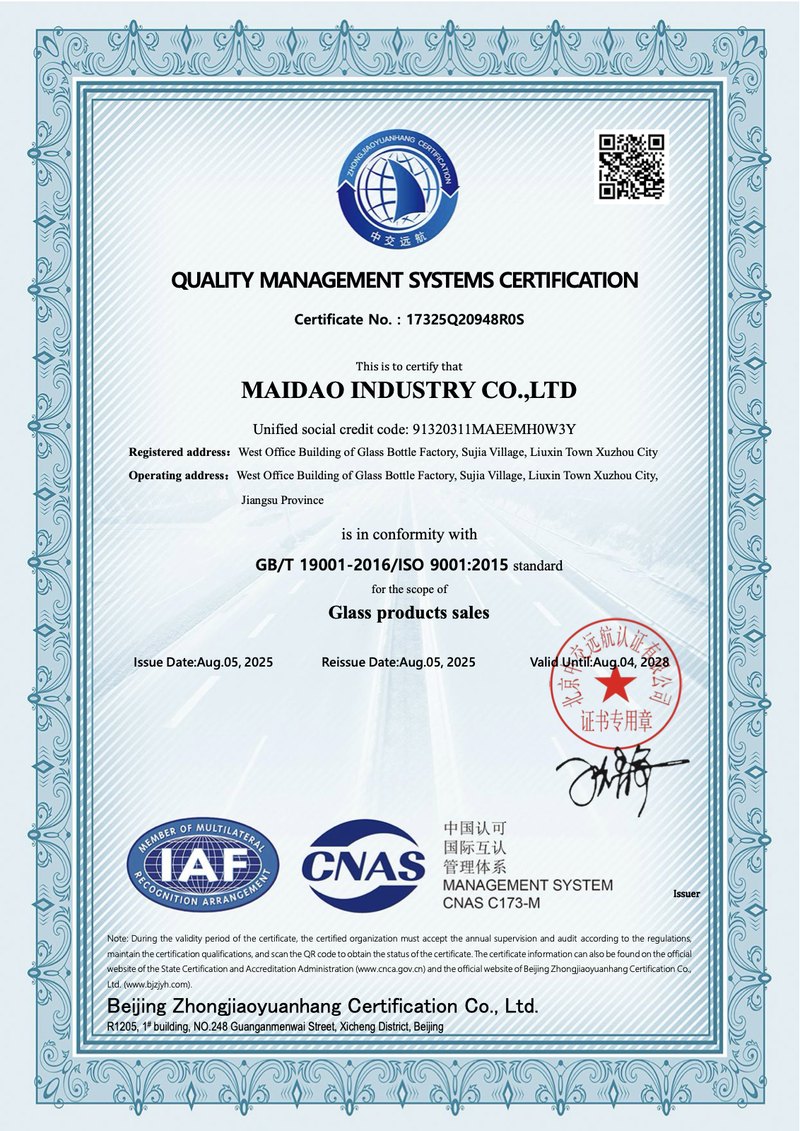
ISO 9001:2015 certificateThe quality management system at Maidao Industry Co., Ltd.Any buyer running a supplier audit.
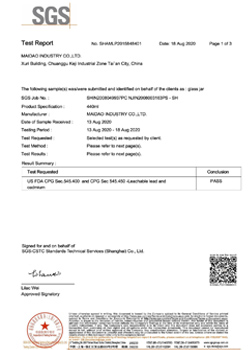
SGS test reportUS FDA CPG leachable lead and cadmium on glass jars — result: pass.US food, beverage and spirits brands.
EC 1935/2004 declarationFood-contact compliance for the EU.EU importers and private-label packers.
California Proposition 65Heavy-metal limits for products sold in California.US retail, and brands selling into California.
RoHSRestricted substances.EU buyers, and retailers who apply it to packaging.
CNAS-accredited lab reportIndependent testing from an accredited laboratory.Buyers commissioning their own tests.

Test Reports on File

Six reports cover the glass and the closures that go on it. MAIDAO holds them under two companies — the Jiangsu company at Xuzhou and the Shandong company — and your quotation names the one your order contracts with. Each report goes out in full with the certificate pack.

ReportSampleTested toResultLaboratoryDate
EBO2307041-C096-1AJiangsu companyGlass jarEU 1935/2004 with 84/500/EEC and 2005/31/EC — migration of lead and cadmiumPassShenzhen EBO Testing Center29 April 2025
EBO2307041-C097-1BJiangsu companyTinplate lidEU 1935/2004 with CoE CM/Res(2013)9 — specific release of heavy metalsPassShenzhen EBO Testing Center29 April 2025
WDX25042284ENJiangsu companyPlastic cover, PP and HDPEGB 4806.7-2023, and GB 9685-2016 Appendix C for specific migration of heavy metalsPassGuangdong Wonder Testing28 April 2025
SHAHL23009845702Shandong companyDark brown glass bottleEC 1935/2004 sensorial examination, and overall migration to the Italian Ministerial Decree of 21/03/1973PassSGS-CSTC Shanghai18 July 2023
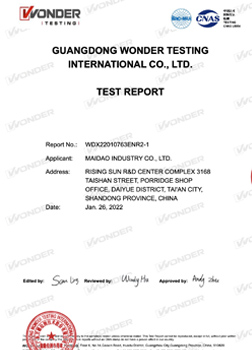
WDX22010763ENR2-1Shandong companyPlastic cap, PPGB 4806.7-2016, and GB 9685-2016 Appendix C for specific migration of heavy metalsPassGuangdong Wonder Testing26 January 2022
WDX22010763ENR2-2Shandong companyInduction seal, aluminium foilGB 4806.9-2016 — sensorial examination and migration of heavy metalsPassGuangdong Wonder Testing26 January 2022

A test report states the result for the sample tested against the standard named beside it. Where your market or your retailer wants the same tests run on your own bottle and closure, independent testing at SGS, TÜV or Bureau Veritas is arranged on request.

ISO 9001:2015 quality management system certificate issued to Maidao Industry Co., Ltd, certificate number 17325Q20948R0S
ISO 9001:2015 certificate 17325Q20948R0S — Maidao Industry Co., Ltd, valid to 4 August 2028
SGS test report on glass jars — US FDA CPG leachable lead and cadmium, result pass
SGS report — FDA CPG lead & cadmium test: pass
Independent laboratory test report for MAIDAO INDUSTRY glass containers
Independent lab test report — Wonder Testing
Technavio market researchMordor Intelligence market research

Listed as a major vendor among glass bottle manufacturers in China in the glass packaging reports of Technavio and Mordor Intelligence.

Downloads: 2026 Catalogue and Certificate Pack

Files you can pass around the buying team. A file that is not yet online goes out by email within one business day.

2026 Product Catalogue
Every stock category with capacities in ml and oz, finishes and colours.
Request by email
Certification and test report pack
ISO 9001, SGS, EC 1935/2004, CA Prop 65, RoHS and CNAS documents in one file.
Request by email

Buyer Questions About Documents, Samples and Loading

The questions a buying team asks once the price is on the table.

Which documents come with a glass bottle quotation?

The finish drawing for the bottle quoted and the loading plan for your cartons and SKU mix. On request: the ISO 9001 certificate, the SGS FDA lead and cadmium test report, the EC 1935/2004 declaration, and the California Proposition 65 and RoHS documents. A polariscope strain report and production drawings for a custom project follow on request as well.

Can I get the product catalogue as a PDF?

Yes. The 2026 catalogue covers every stock category with capacities in ml and oz, finishes and colours, and goes out by email within one business day until the download link is live.

Do you send the finish drawing before I place an order?

Yes. Every quotation carries the finish drawing, so your closure supplier confirms the match on paper before you commit a container to it, and a sample of your existing cap comes back matched to the stock finishes that fit.

Can a polariscope strain report travel with my shipment?

Yes, on request. Every batch gets a polariscope check at the site as routine; the written report is not part of the standard shipping documents, and it joins your paperwork when you ask for it at order stage.

Are stock samples free?

Yes. Stock samples are free, and a custom project's decorated samples come off the sample mould at the $1,200 stage, 5–10 pieces in the decoration you sign off.

Is there a minimum order on stock glass bottles?

No tooling minimum on existing moulds: your first order is a pallet if that is all you need, and a container when you scale. Custom moulds start at 12,000 pieces in extra-flint or 50,000 in standard flint, the numbers we quote your competitors too.

Latest From the Blog

Supplier comparisons, market notes and mould economics from the same factory.

Need a Document You Don't See Here?

Polariscope strain results for your batch, third-party inspection by SGS, TÜV or Bureau Veritas before loading, an NDA before you send drawings, and production drawings for a custom project — all available on request.

Request documents

sales@sgsbottle.com · Mon–Sat 8:30–18:00 (GMT+8)