

Your decoration on glass comes down to a choice between something fused into the surface and something stuck onto it. Both look good on day one. They diverge in your dishwasher, your returnable crate, your fridge and your cost per bottle.
The 5 Differences
| Fired print | Label | |
|---|---|---|
| Durability | Permanent. Ceramic ink fuses to the glass in a lehr. | As durable as the stock and the adhesive you chose. |
| Colour range | Solid colours, one screen pass each; metallics available. | Anything a press prints, including photographs and gradients. |
| Cost driver | A screen and a pass per colour, spread across your run. | Material and application per bottle, plus waste. |
| Minimum | A set-up per design, so short runs carry it heavily. | Low, and short runs are easy. |
| Lead time | Screens are made once, then production runs. | Fast, once your label stock is printed. |
Where a Fired Print Earns Its Place
Your long runs and repeat orders, where the screen cost disappears into volume. Your products that meet water: beer in an ice bucket, a bathroom bottle, anything in a dishwasher. Your returnable and refill programmes, where a label would not survive the wash. And your designs built on one or two solid colours, which covers most spirits and much of beauty.
A second, quieter reason follows. Your printed bottle reads as a considered product, and a paper label on the same glass reads as a first run. When your brand is moving up a tier, that difference is worth more than the print costs you.
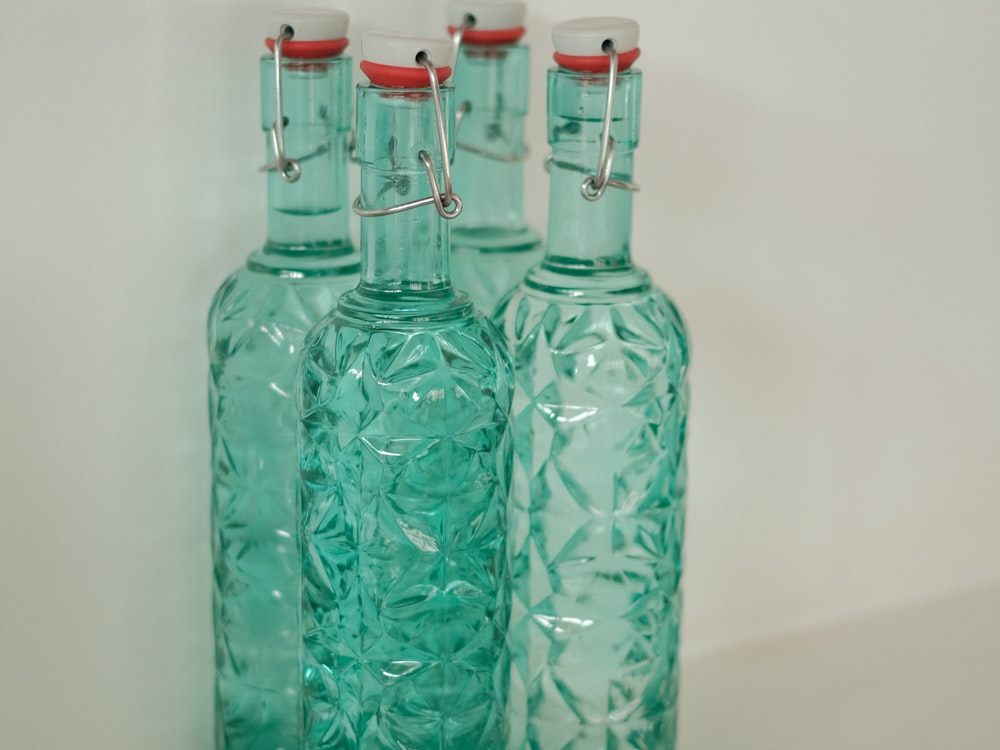 Decoration fused into or formed with the glass survives everything your fill and your shelf do to it.
Where a Label Earns Its Place
Your complex artwork, first of all. Photographs, gradients, many-colour illustrations and small type all belong on a press instead of a screen.
Then flexibility. A label lets you run variants, batches, vintages, limited editions and market-specific text on one bottle, and change any of them without touching your glass supply. For your range with many SKUs and one shape, that is decisive.
Your regulatory text belongs there too. Nutrition panels, allergen statements, duty marks and market-specific warnings change often enough that fusing them into your glass becomes a liability.
The Combination Most Brands Use
Most brands print the permanent part and label the changeable part: a fired logo or wordmark on the body, and a paper or clear label carrying your vintage, batch and regulatory panel. Your glass supply stays stable, your artwork stays flexible, and your bottle still reads as printed.
Embossing joins the same logic from the other side. A mark cut into your mould costs nothing per bottle and never wears, so your range can carry an embossed base, a fired print on the body and a label at the back. SGSBOTTLE cuts that mark once, at 14 lines in Shandong and Xuzhou.
What Your Surface Does to Both
Your coated or frosted bottle changes both processes. Fired ink goes on before or after a coating depending on the effect, and your label needs an adhesive matched to that surface. A coated body and bare glass behave differently, and a label lifting at its edge is usually your adhesive.
SGSBOTTLE frosts, sprays, screen prints, applies decals, hot stamps, electroplates and labels in-house at our decorating plant in Shandong, opened in 2020, so a decorated sample comes off the same site that forms the glass.
What Goes on Your Enquiry
The artwork with its colour count, the fill and where your bottle goes after it, the run size, and whether the pack is one-trip or returnable. SGSBOTTLE returns a decorated sample from the Shandong plant against your Pantone reference before a run is committed.