
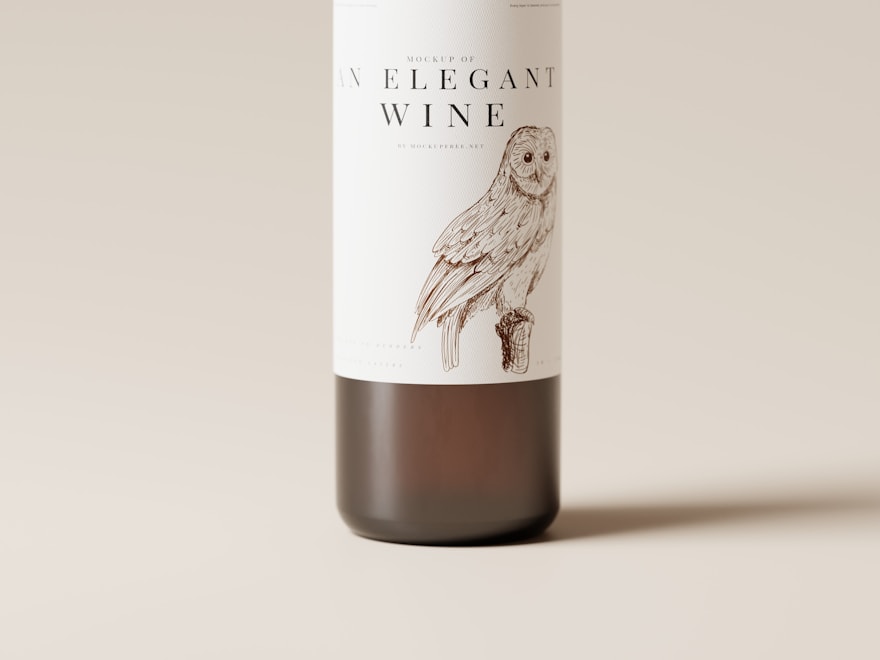
Foil gives you a metallic finish no ink can match. It also asks something specific of your bottle, because a heated die has to meet the glass evenly across the whole mark, and glass does not flex to help.
How the Foil Reaches Your Glass
A roll of foil passes between the die and your bottle. The die heats, presses, and the heat releases a pigment and adhesive layer from the carrier film, which bonds to the glass in under a second.
The carrier moves on and the mark stays. Nothing gets fired, so hot stamping costs less to set up than a ceramic process, and a change of design means a new die rather than a new screen and firing schedule.
The 3 Rules Your Panel Has to Follow
| Rule | Why the die needs it | What you see when it is broken |
|---|---|---|
| Even contact | Foil transfers only where die, foil and glass all meet. | Patchy edges and gaps in the middle of your mark. |
| No seam under the mark | A mould parting line raises the surface fractionally. | A visible break running through your logo. |
| Bounded size | Force and heat spread across the whole die face. | Weak transfer at the extremes of a large stamped area. |
What Foil Can and Cannot Carry
Think in solids. Gold, silver, copper, coloured and holographic foils all transfer as a single dense layer, which makes a logo or a border read brilliantly.
Tonal work has nowhere to go. Gradients, photographic detail and fine screens do not exist in foil, so a design needing them belongs on a decal, and a 330 ml (11 oz) bottle carrying both usually splits the work between the two.
 Metallic detail suits a defined panel. SGSBOTTLE stamps in Shandong, beside 14 forming lines.
Where Hot Stamping Sits Against a Fired Print
Cost and speed favour foil on short runs. There is no screen to make per colour, no firing pass, and a die is quick to produce, so a limited edition reaches you faster.
Durability favours ceramic. A fired print becomes part of your glass, while foil sits on the surface, so anything washed, returned or heavily handled points back at printing. SGSBOTTLE runs both in Shandong, next to the 14 forming lines, and quotes them side by side.
Combining Foil With Other Decoration
Foil earns its keep as an accent. A spray-coated or frosted 750 ml (25 oz) bottle with a stamped logo gives you contrast that neither process delivers alone, and the metallic reads strongly against a matt ground.
Plan the order of operations, since coating comes before stamping and the coated surface changes how the foil grips. Ask for a sample carrying both, on your own bottle, before you fix the artwork.
What Goes on Your Enquiry
Vector artwork for the mark, the foil colour you want, the panel and its position, and the format in ml and oz. SGSBOTTLE comes back with a stamped sample on your bottle, the die cost and the minimum for your project.