
Glass is the rare packaging material that returns to itself. A bottle melts back into the same glass with no loss of quality, and the crushed material that does it is called cullet. How much of it reaches your bottle decides energy, emissions and the sustainability figure your buyer asks for.
What Cullet Is, and Where It Comes From
Two streams feed a furnace, whether it is making a 50 ml (1.7 oz) jar or a 1 L (34 oz) bottle. Internal cullet is the plant's own material: bottles rejected at inspection, trimmings and the glass that runs while a machine is set up. It is clean, its composition is known, and it goes straight back.
External cullet comes from collection. Kerbside schemes, bottle banks and deposit-return systems gather it, and processors sort it by colour, remove ceramics, metal and organics, then crush it to a usable size. Your recycled-content claim rests on this second stream.
What Cullet Does to Your Melt
| Effect | What happens |
|---|---|
| Energy | Cullet melts under the temperature raw batch needs, so every point of it cuts fuel per tonne. |
| Emissions | Less fuel means less CO2, and limestone that never melts releases no process CO2 either. |
| Raw material | Each tonne of cullet displaces roughly a tonne of sand, soda ash and limestone. |
| Furnace life | A steadier, cooler melt is gentler on refractory, which extends a campaign. |
| Quality | Clean cullet changes nothing your customer can see. Contaminated cullet becomes stones and inclusions. |
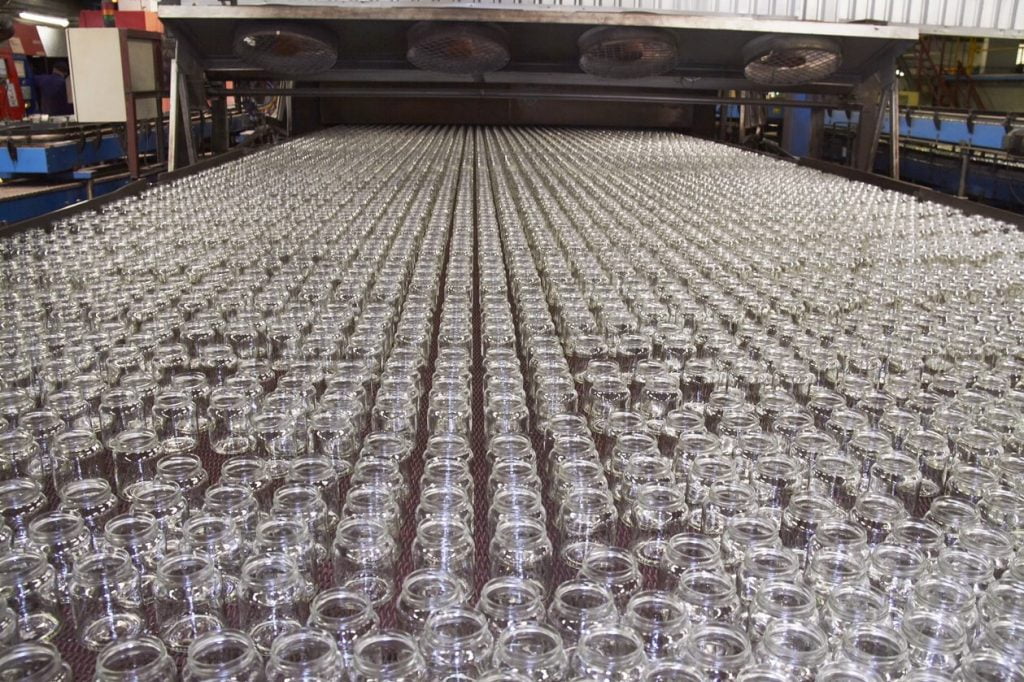 Rejected bottles go straight back into the furnace, which is why a glassworks wastes very little glass.
Why Colour Limits How Much You Get
Cullet carries its colour into the melt, so a flint furnace can only take flint cullet. Amber and green tolerate a mixed stream far better, because a trace of the wrong colour disappears in glass that is already dark.
That asymmetry explains a pattern you will see in quotations. Green and amber bottles often carry a higher recycled share than clear ones in the same market, and a clear bottle with a very high claimed content usually depends on a well-sorted local stream. SGSBOTTLE melts flint, amber and super flint on the 7 lines in Shandong, and the cullet share sits at 20 to 30 percent across them.
What Contamination Actually Costs You
Ceramics are the worst offender. A fragment of a cup or a plate does not melt at furnace temperature and ends up as a stone in the sidewall of your 500 ml (17 oz) bottle, which counts as a critical defect. Metal causes similar trouble, and organics burn off but disturb the melt.
That is the reason cullet processors invest so heavily in sorting, and the reason a glassworks will refuse a stream it cannot trust. When your recycled-content target is ambitious, the honest conversation is about the quality of the local stream rather than about willingness.
How to Ask for the Figure
Three things make a recycled-content statement defensible. Ask for the average cullet share of the melts your order ran on, since a furnace runs continuously and no single bottle carries its own number. Ask whether internal or external cullet is included, because the two mean different things to a retailer. And keep the claim in the form your supplier can evidence, because a packaging claim you cannot document is a liability rather than an asset.
What Goes on Your Enquiry
The colour, the format in ml and oz, and the recycled-content figure your buyer asks for. SGSBOTTLE engineers come back with the cullet share of the melts running now and what a higher figure would mean for your colour and your schedule.