
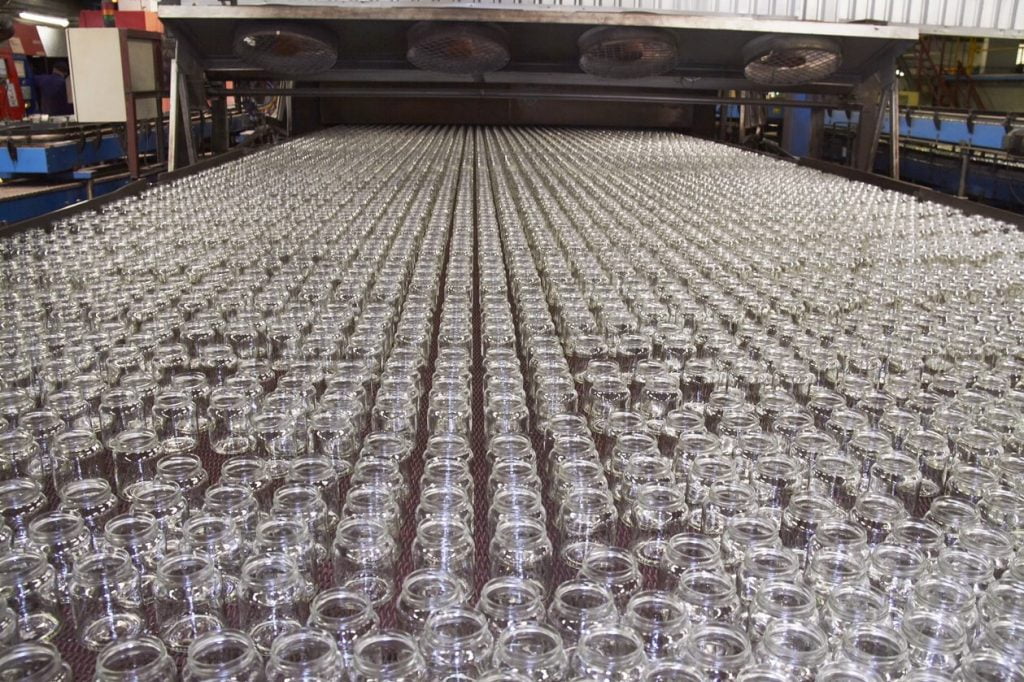
Every quotation, finish drawing and inspection report you get from a glass factory uses the same few dozen words, and half of them mean something narrower than they sound. These definitions are the ones SGSBOTTLE's engineers work to on 14 lines, written with the cost of getting each one wrong, so your specification says what you mean the first time.
Glass Grades and Colours
| Term | What it means for your order |
|---|---|
| Soda-lime glass | The standard container glass: silica sand, soda ash and limestone. Every stock bottle and jar in the SGSBOTTLE catalogue is soda-lime unless the product page says otherwise, and it is the material your food-contact declarations refer to. |
| Flint | Clear soda-lime glass. In a thick base or heel it shows the faint green of the iron in ordinary sand, invisible in a 250 ml (8 oz) jar and visible in a 1 L (34 oz) decanter. |
| Extra-flint (super-flint) | Flint melted from low-iron sand, water-white at any thickness. Your spirits, perfume and diffuser bottles run in it in Shandong, and a custom mould there starts at 12,000 pieces. |
| Amber | Brown glass coloured in the melt with iron and sulphur. It blocks the ultraviolet band that spoils beer, oils and botanical extracts; a clear bottle leaves that job to the carton. |
| Green | Coloured in the melt, from the deep antique green of olive oil bottles to the paler green of wine. Partial UV protection, and a colour your buyer reads as oil or wine before the label is on. |
| Cobalt, black and coated colours | Cobalt blue and black are furnace colours with their own campaigns and minimums. Pink, gold and most pastels on stock bottles are spray coatings over flint, which change the look and stop light only as far as the thickness of the coat allows. |
| Cullet | Crushed recycled glass fed back into the furnace. SGSBOTTLE furnaces run 20 percent cullet on average and up to 30, which lowers melting energy and is the recycled content your sustainability sheet can quote. |
| Batch | The weighed mix of sand, soda ash, limestone and cullet that goes into the furnace. A batch recipe is a furnace decision, so a colour or a grade you specify has to be one the base is already melting. |
| Borosilicate | A glass with boron oxide for higher thermal-shock resistance. A handful of SGSBOTTLE designs use it; every other item is soda-lime, and the product page names the material per model. |
Forming Terms on a Mould Drawing
| Term | What it means for your order |
|---|---|
| Gob | The measured lump of molten glass cut from the furnace feeder and dropped into the mould. Gob weight sets your bottle weight, at the feeder, before the glass touches metal. |
| IS machine | The individual-section machine that forms bottles: six, eight or more identical sections, each with its own blank and blow mould, running side by side. The 6S and 8S machines in Shandong carry six and eight sections each. |
| Blow-and-blow | The forming process for narrow-neck bottles: compressed air settles the gob into the blank mould and blows the parison, then a second blow finishes the shape. The default for your spirits or beer bottle. |
| Press-and-blow | A plunger forms the parison in the blank mould, then air blows the final shape. Better wall control, the property a wide-mouth jar needs. |
| NNPB | Narrow-neck press-and-blow, the plunger process applied to bottles. It spreads the glass more evenly, so a bottle weighs less for the same strength; the 7 lines in Shandong run on it. |
| Parison | The intermediate hollow shape formed in the blank mould before the final blow. Where the parison is thick, your finished bottle is thick; wall-thickness distribution takes shape here. |
| Blank mould and blow mould | The two halves of forming: the blank mould shapes the parison and the finish, the blow mould gives the body its final form and any embossing. A mould set is both, plus the neck ring that forms the finish. |
| Cavity | One bottle-shaped hollow in a mould. A two-cavity mould forms two bottles per section per cycle, so it doubles output and costs more to cut, which shows in your tooling quote. |
| Mould seam | The faint vertical line where the two mould halves meet. It is normal on every blown bottle; a sharp or offset seam is a defect, and a seam through a screen-print panel is an artwork decision for the drawing stage. |
| Embossing and debossing | Lettering or a pattern raised from, or sunk into, the glass surface by the blow mould. Cut into your mould once and free on every bottle afterwards, which makes it the cheapest permanent branding in glass. |
| Heel, shoulder and finish | The three zones of a bottle from the bottom: the heel where the base meets the sidewall, the shoulder where the body narrows to the neck, and the finish at the top that carries the closure. Impact breakage most often starts at the heel. |
| Push-up (punt) | The dome pressed into the base of a wine or spirits bottle. It adds stability and base strength, and it changes your brimful capacity, so it is on the drawing you approve. |
| Lightweighting | Taking grams out of a bottle without losing strength, through NNPB and better glass distribution. Less glass costs you less per bottle and per tonne of freight, and lowers the carbon figure your buyer asks for. |
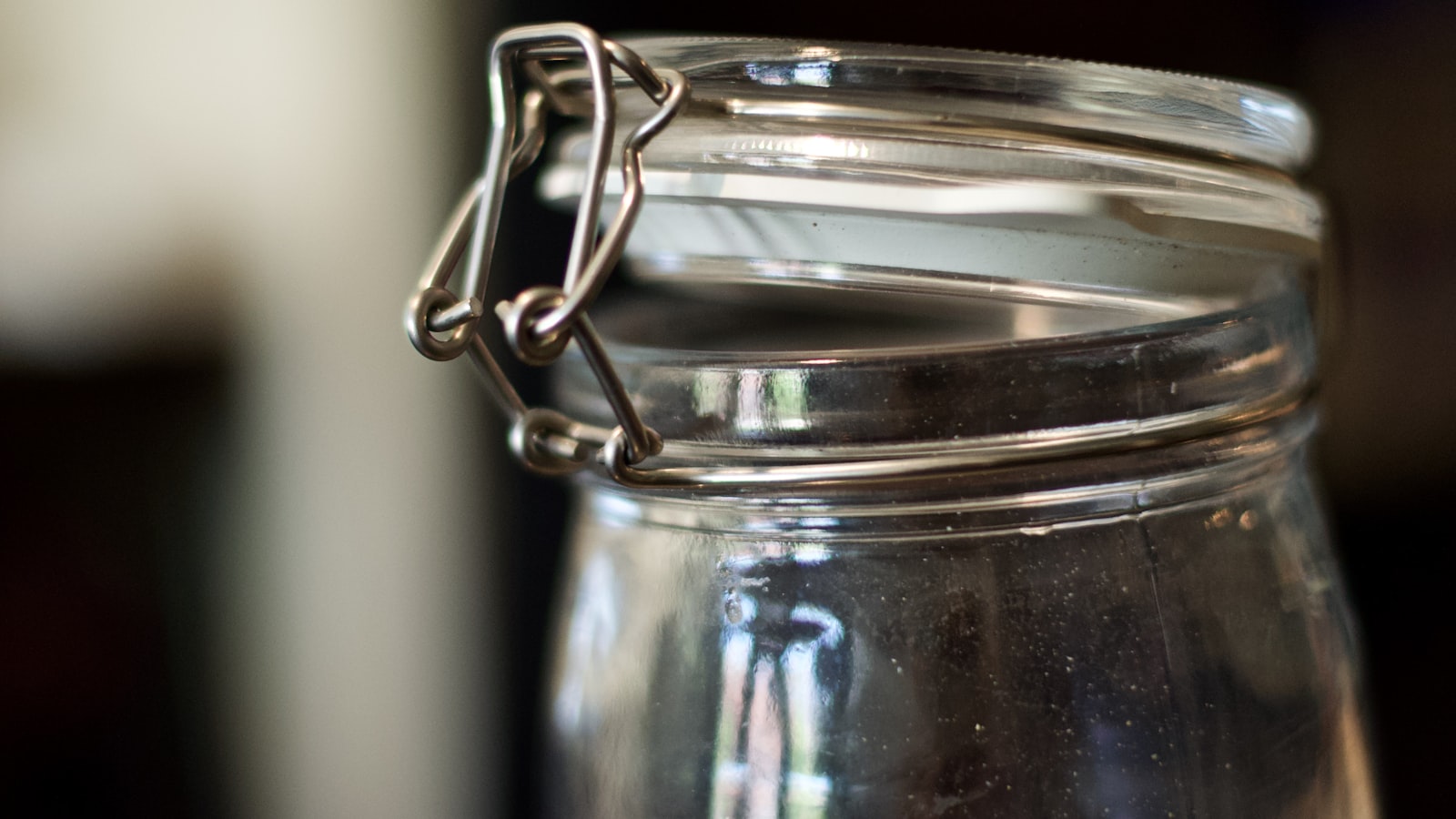 A clip-top finish: the ring your bail locates on, and the flat glass your gasket seals against.
Finish and Closure Terms on Your Drawing
| Term | What it means for your order |
|---|---|
| Finish | The top of the bottle that takes the closure: threads, lugs, a crown lip or a cork bore. Your cap supplier signs off against its drawing, with the T, E, I and H dimensions. |
| Finish designation | The number pair on a threaded finish, such as 43-400 or 28-410: outer thread diameter in millimetres, then the thread style. Two suppliers quoting you the same designation are quoting parts made to match. |
| T, E, I and H | The four dimensions on a finish drawing: T the outside of the thread, E the root of the thread, I the inside bore, H the height from the sealing surface to the bottom of the finish. A cap fits when its own T and E land inside the tolerance band on your drawing. |
| Continuous thread (CT) | A thread that runs unbroken around the finish, closed by a screw cap. The 400, 410 and 415 series differ in how many turns the thread makes and how tall the finish is. |
| Lug or twist-off (TO) | A finish with four or six short thread segments instead of a continuous thread, closed by a metal vacuum cap with a quarter turn. Standard on jam, honey and sauce jars; 58 TO, 63 TO and 70 TO name the cap diameter in millimetres. |
| Crown | The 26 mm lip on a beer bottle that a crimped crown cork grips. A crown finish is the same across the industry, so your capper does not change when the bottle does. |
| Swing top | A finish with a wire bail and a ceramic or plastic stopper on a rubber gasket, reclosable without tools. Its pressure rating decides whether it suits your fermented drink. |
| Bar-top (cork mouth) | The plain bore finish of a spirits bottle that takes a T-cork or a synthetic stopper. Bore diameter and its tolerance decide whether the stopper seats with the right pull force. |
| ROPP | Roll-on pilfer-proof: an aluminium closure whose thread the capping head rolls onto the finish. Common on wine, spirits and olive oil; the finish is a specific ROPP profile, and it decides the capping head you run. |
| Crimp finish | The 15 mm or 20 mm plain neck on a perfume bottle that takes a crimped-on spray pump. The crimp size is the first thing a fragrance buyer asks and the first line on the drawing. |
| Sealing surface | The flat ring at the very top of the finish that the cap liner presses against. A chip, a dip or a line across it is a leak, so every SGSBOTTLE bottle gets its sealing surface inspected before packing. |
| Bore | The inside diameter of the finish. It sets whether a cork, a dropper or a pourer fits, and what your fill nozzle can pass through. |
| Liner | The disc inside a cap that makes the actual seal against the sealing surface: foam, pulp, foil induction or a plug. The liner and the sealing surface are chosen together; a hot-fill liner on a cold-fill sealing surface leaks. |
| Dropper, pump and roll-on | Dispensing closures for the beauty range: a glass pipette in a threaded collar, a lotion or spray pump, and a ball in a plastic fitment. Each fixes a finish size, so the closure you already buy decides which SGSBOTTLE bottle fits. |
Capacity, Weight and Tolerance Terms on Your Quotation
| Term | What it means for your order |
|---|---|
| Nominal capacity | The declared volume: what your label says and your filler targets. A 500 ml (17 oz) jar holds 500 ml at its fill point, with headspace over it. |
| Brimful (overflow) capacity | The volume to the top of the finish. The number a jam packer sizes headspace against, and the figure some customs codes ask for. |
| Fill point (fill level) | The height from the base, or the distance from the top, at which the nominal volume sits. A consistent fill point keeps a shelf of your bottles looking equally full. |
| Headspace | The air between the fill point and the closure. Hot fills, carbonated fills and freezer products each need their own headspace, so the fill you intend goes into the quotation. |
| ml and fl oz | Millilitres and fluid ounces. A US fluid ounce is 29.57 ml and an imperial one 28.41 ml: 8 US oz is 237 ml, 12 oz is 355 ml, 16 oz is 473 ml, and 750 ml is 25.4 US oz. Product pages carry both, because a US buyer searches in ounces and a filler runs in millilitres. |
| Glass weight | The mass of the empty bottle, set by the gob. It drives your glass price, your freight and your carbon number, and a heavy bottle is a sensory cue a premium spirits buyer pays for on purpose. |
| Wall-thickness distribution | How evenly the glass is spread around the bottle. Thin spots decide pressure resistance and breakage in transit; an NNPB bottle is more even than a blow-and-blow one at the same weight. |
| Tolerance | The permitted variation on each dimension, stated on the drawing: capacity, height, diameter, finish. You set up your labeller, capper and case packer to the tolerance, so a tolerance you never asked about is one you are already living with. |
| Verticality (lean) | How far the finish sits from the true vertical axis of the base. Past the tolerance, a bottle jams in a capping head or leans in a carton. |
| Ovality | The difference between the largest and smallest diameter of a nominally round bottle. Labels and shrink sleeves show it first, on your shelf. |
Decoration Terms for Your Artwork
| Term | What it means for your order |
|---|---|
| Frosting | An acid or sand treatment that turns the surface matte and translucent. Full-body, partial or gradient; it softens the visible fill level and takes a screen print on top. |
| Spray coating | A colour lacquer sprayed over the bottle and cured. Opaque, translucent or gradient, matte or gloss, any Pantone: the way a flint bottle becomes pink or black without a furnace colour. |
| Screen printing (ACL) | Ink pushed through a screen onto the glass and fired on, one colour per pass. Permanent and dishwasher-safe; fine text and multi-colour artwork cost you a pass per colour. |
| Decal | Printed transfers applied to the glass and fired. For photographic or many-colour artwork a screen cannot carry, and for your small runs where screens do not pay. |
| Hot stamping | Metallic or pigment foil pressed onto the glass with a heated die. Gold and silver logos on spirits and perfume bottles; it needs a flat or gently curved panel. |
| Electroplating | A metallic finish, gold, silver or gunmetal, deposited on the glass. The most premium and the most process-sensitive of the coatings; Shandong runs it in-house. |
| Label panel | The flat or gently curved area of the body the drawing reserves for a label. Its height and circumference are the numbers your label printer needs before the bottle exists. |
| Pantone reference | The colour standard a spray coat or a print matches to. Your decorated sample from the sample mould is the proof against it, signed off before production. |
Quality and Testing Terms
| Term | What it means for your order |
|---|---|
| Annealing | Controlled slow cooling after forming, in the lehr, that lets forming stress relax out of the glass. Under-annealed glass passes a visual check and cracks weeks later on your filler or in the pallet. |
| Lehr | The long tunnel oven bottles pass through after forming, holding them at annealing temperature and then cooling them on a set curve. The lehr profile is part of the quality record for your batch at each SGSBOTTLE base. |
| Polariscope | An instrument that shows residual stress in glass as coloured bands under polarised light. Every SGSBOTTLE line runs a polariscope check as routine; the written report joins your shipment on request. |
| Thermal-shock resistance | How large a sudden temperature change the bottle takes without cracking, tested between hot and cold water baths. It sets your hot-fill and pasteurisation limits, so the fill you intend goes on the quotation. |
| Internal pressure resistance | The pressure a bottle holds before bursting, in bar or psi. The one number that decides a beer, sparkling or fermented-drink bottle; you specify a swing-top or crown bottle to it. |
| Vertical load | The top-down force a bottle takes on the capping head and under a stacked pallet. It matters most for your lightweight bottles and tall stacks. |
| Hot-end coating | Tin-oxide vapour applied while the bottle is still hundreds of degrees, closing micro-cracks in the surface. Shandong runs it; it is the foundation of the strength of your bottle. |
| Cold-end coating | A lubricant emulsion sprayed after the lehr so bottles slide past each other on the conveyor instead of scratching. A scratch made in the plant costs strength for good and usually shows up as breakage a month later in transit; Shandong runs it after the lehr. |
| AQL | Acceptable quality limit: the sampling plan and defect thresholds an inspection follows, written in your order or your third-party inspector's brief. |
| Critical, major and minor defects | The three defect classes in an AQL plan. A critical defect makes the bottle unsafe or unusable (a crack, a sealing-surface chip); a major one makes it unfit for your purpose (a bad finish, a stone); a minor one is cosmetic. Each class carries its own acceptance number. |
| Surface check | A shallow crack in the glass surface, most often at the finish or the heel. Every check is a critical defect because it grows under load. |
| Stone | An unmelted or crystalline inclusion in the glass. A stone in the wall is a stress point and a critical defect; a stone in a thick base usually counts as major on your AQL. |
| Seed and blister | Small (seed) and large (blister) gas bubbles trapped in the glass. Seeds within your AQL are normal in every container glass; a blister at the finish or in a print panel is a reject. |
| Cord | A streak of glass of a different composition, visible as a wavy line, from imperfect mixing in the furnace. Cosmetic in most fills, a reject in your clear spirits bottle. |
Compliance Terms Your Broker Asks For
| Term | What it means for your order |
|---|---|
| FDA (US) | The US regulator for food-contact materials. For glass the test that matters is leachable lead and cadmium under the FDA Compliance Policy Guide; SGSBOTTLE's SGS report on glass jars shows a pass. |
| EC 1935/2004 | The EU framework regulation for materials in contact with food. An EU importer asks you for the declaration of compliance under it on the first order. |
| Declaration of Compliance (DoC) | The supplier's written statement that a material meets a named regulation. Yours for glass names EC 1935/2004 and, on request, the test reports behind it. |
| California Proposition 65 | California's law on chemicals that require a warning. For glass packaging the exposure in question is lead and cadmium in decoration; a Prop 65 statement covers products sold into California. |
| RoHS | The EU restriction on hazardous substances, written for electrical equipment and applied by many retailers to packaging. A RoHS statement covers the restricted-substances list. |
| ISO 9001 | The quality management system standard. Maidao Industry Co., Ltd holds an ISO 9001:2015 certificate, the document your supplier audit opens with. |
| CNAS | The Chinese accreditation body for laboratories and a signatory to the ILAC mutual recognition arrangement, so the accreditation bodies of your own market recognise an accredited report from a Chinese lab. |
| Certificate of Analysis (CoA) | A per-batch document stating test results against the specification. It comes on request for the batch you receive. |
Ordering and Shipping Terms
| Term | What it means for your order |
|---|---|
| MOQ | Minimum order quantity. On existing moulds SGSBOTTLE has no tooling minimum, so a first order can be one pallet; a custom mould starts at 12,000 pieces in extra-flint or 50,000 in standard flint. |
| Existing mould | A design already cut and running, which is every stock item in the catalogue. No tooling cost, no tooling wait, and the sizes are the ones on the product page. |
| Custom mould | Tooling cut to your drawing, in three stages: an acrylic prototype at $500 in about 10 days, a sample mould at $1,200 in 35 days, and production tooling at $1,200 to $2,200 on a 700 to 750 ml (24 to 25 oz) basis. |
| Sample mould | A single-cavity mould that produces your first real glass, 5 to 10 decorated samples, for sign-off before production tooling. Only a design already proven in production elsewhere skips it. |
| Acrylic prototype | A machined model of your bottle in acrylic, to hold and photograph before anyone cuts steel for your mould. $500 and about 10 days. |
| Mould ownership | The production mould cut to your drawing is yours; it runs for your orders and for nobody else's, and we sign an NDA on request. |
| Lead time | The interval between order confirmation and the goods being ready, stock or custom. It goes on your quotation as a date, because it moves with the furnace schedule and the decoration. |
| EXW | Ex works: you or your forwarder collect at the factory gate in Shandong or Jiangsu, and everything from there is yours to arrange. |
| FOB | Free on board: the price covers delivery onto the ship at the Chinese port, and the sea freight, insurance and import side are yours. |
| 40HC and 20GP | The two container sizes glass ships in. A 40-foot high cube holds about 25,000 bottles of 750 ml (25 oz) in standard shapes, 22,000 in irregular ones, or 60,000 of 12 oz (355 ml); a 20-foot standard box holds roughly 40 percent of that by volume. |
| Bulk loading | Loading with no pallets: bottles in layers on the container floor with pads and dividers, or cartons stacked straight onto the floor by hand. More bottles per box, and unloading by hand at your end of the voyage. |
| Palletised loading | Bottles shrink-wrapped in layers on pallets, or in cartons on pallets. Fewer bottles per container, faster unloading, and what most fillers with a forklift ask for. |
| Layer pad and divider | The corrugated or plastic sheets between layers and between bottles in a bulk or tray pack. They are the reason your bottles arrive without the scuffs that cost strength. |
| Landed cost | What a bottle costs at your door: glass price, decoration, pallets or cartons, inland haul, sea freight, duty, port and delivery, divided by the count that actually fits in the container. |
| Pre-shipment inspection (PSI) | A third-party check at the factory before loading, by SGS, TÜV, Bureau Veritas or your own inspector, against the AQL in your order. Available on request before every container. |