
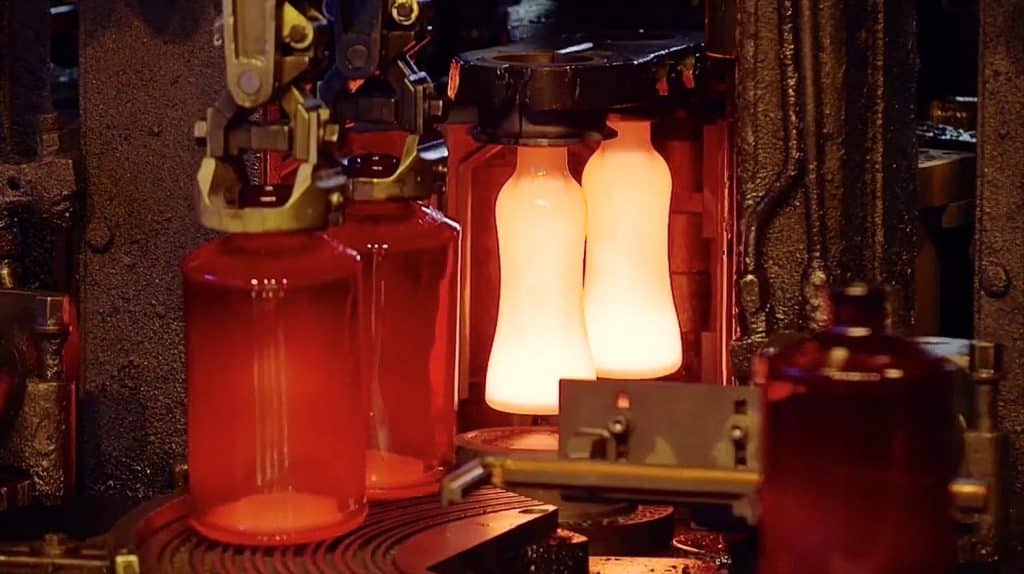
Every glass bottle you buy from SGSBOTTLE goes through the same eight steps in Shandong and at Xuzhou in Jiangsu, 14 production lines in all. Each step sets a number you later read on a quotation or an inspection report: weight, wall thickness, clarity, strength, count per pallet. The sequence runs from a weighed pile of sand to a container plan, and each stage closes a decision your order depends on.
Step 1. The Batch: Sand, Soda Ash, Limestone and Cullet
The batch is a weighed recipe: silica sand, soda ash, limestone, small amounts of stabilisers, and cullet, the crushed recycled glass that SGSBOTTLE furnaces run at 20 percent on average and up to 30. Cullet melts at a lower temperature than raw sand, so every point of it saves furnace energy, and it is the recycled-content figure your sustainability sheet can quote.
Colour comes from the batch too: iron and sulphur for amber, chromium for green, and low-iron sand for the extra-flint that reads water-white in a spirits bottle. For you, the batch means colour and grade are furnace decisions. A colour the base is not melting is a campaign with its own minimum and its own date, never a stock pick.
Step 2. Melting: A Furnace Runs One Colour at a Time
The batch melts at around 1,500 °C in a furnace that runs day and night for years between rebuilds; nobody switches a furnace off for a small order. SGSBOTTLE's furnaces have run on natural gas since 2016, which cuts the CO2, SO2 and NOx per tonne of glass against coal-fired melting. The Shandong lines and the Xuzhou lines form 2 million pieces a day between them, 7 lines at each site.
One furnace, one colour. A furnace melting amber stays amber for the length of the campaign, so a coloured custom body carries a minimum and a date, and the stock colours are the ones the two sites are melting this quarter.
Step 3. Gob and Feeder: Where Your Bottle Weight Is Set
Molten glass flows from the furnace through a forehearth to the feeder, where shears cut it into gobs of a set weight. Gob weight is bottle weight: a 750 ml (25 oz) spirits bottle specified at 500 g and the same shape lightweighted to 420 g are two feeder settings, and two freight bills. The weight and its tolerance go on your drawing, and the line checks every bottle that follows against it.
Step 4. Forming on the IS Machine: Blow-and-Blow, Press-and-Blow and NNPB
The gob drops into the blank mould of an IS (individual section) machine, and the finish forms first: the neck ring shapes the threads or the crown lip while the glass is still hot enough to move. Then the parison, the hollow intermediate, forms one of three ways.
- Blow-and-blow. Compressed air settles the gob and blows the parison. The default for narrow-neck bottles.
- Press-and-blow. A plunger forms the parison, which gives wide-mouth jars their even walls.
- NNPB, narrow-neck press-and-blow. The plunger process on bottles: the glass spreads more evenly, so your bottle weighs less at the same strength.
The 7 lines in Shandong run NNPB for flint and amber at volume. The Shandong lines form super flint spirits bottles on IS, 6S and 8S machines, and Xuzhou's 7 lines run up to eight products at once for mixed and smaller orders. The parison then transfers to the blow mould, air blows it to the final shape, and any embossing cut into the mould prints itself onto the glass. The parison decides wall-thickness distribution, and a bottle that meets weight can still fail a pressure test when the glass sits in the wrong place.
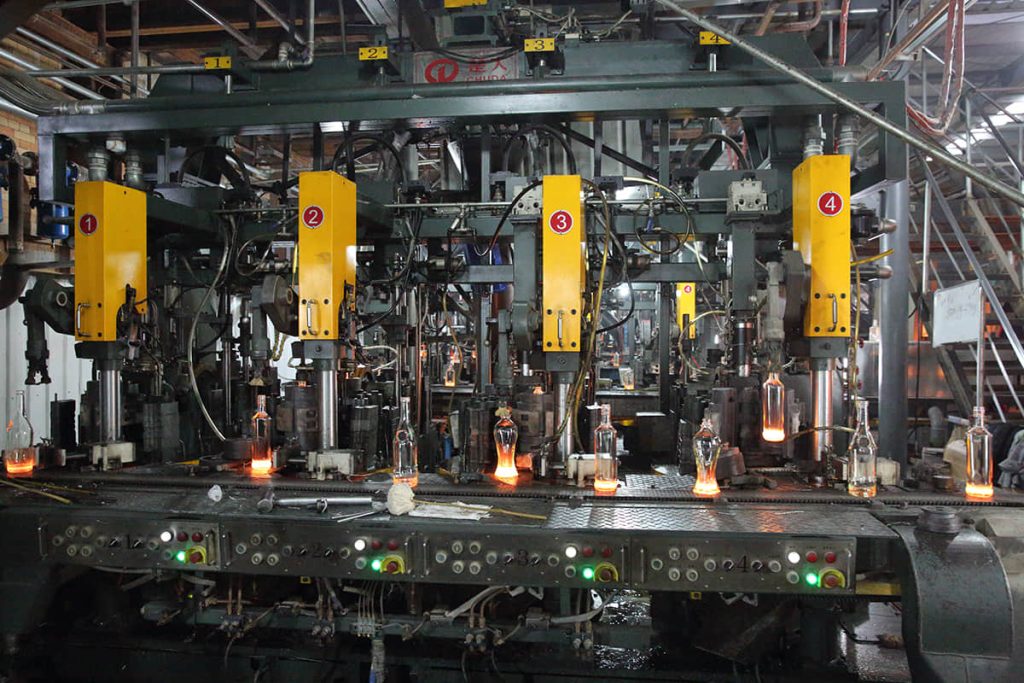 An IS machine at work: the neck ring forms your finish first, while the glass is still soft enough to move.
Step 5. Hot-End Coating: Strength Sealed In Before the Lehr
Straight out of the mould, at several hundred degrees, the bottle passes through a hood that deposits a tin-oxide film on its surface. The film closes the micro-cracks that forming leaves behind and gives the cold-end coating something to bond to. Glass strength is almost entirely a surface property, so this step matters more than its thickness suggests; Shandong runs it on its flint lines.
Step 6. Annealing: The Hour That Decides Whether Your Bottles Crack Later
The formed bottle carries stress from the temperature difference between its inside and its outside. The lehr, a tunnel oven, brings every bottle back up to the annealing point and then cools it on a controlled curve over roughly an hour, so that stress relaxes out. A bottle that leaves the lehr too fast looks perfect and cracks later: on your filler, under a hot fill, or in a pallet three weeks into a sea voyage. Every SGSBOTTLE line runs a polariscope check as routine to read the residual stress as coloured bands, and the written report joins your shipment on request.
Step 7. Cold End: Coating and 100 Percent Inspection
After the lehr in Shandong, a cold-end coating goes on: a lubricant emulsion that lets bottles slide past each other on the conveyor instead of scratching. A scratch made in the plant costs strength for good and usually surfaces as breakage weeks later in transit.
Then inspection. In Shandong automatic inspection machines check the finish and sealing surface of every bottle and an inspector checks behind them; at Xuzhou inspectors check 100 percent of pieces by hand, with a random check every two hours, twelve times a day. Both sites verify capacity by water-fill weight as routine and inspects the finish and sealing surface of every bottle before packing, because a chip on a sealing surface is a leak on your customer's shelf.
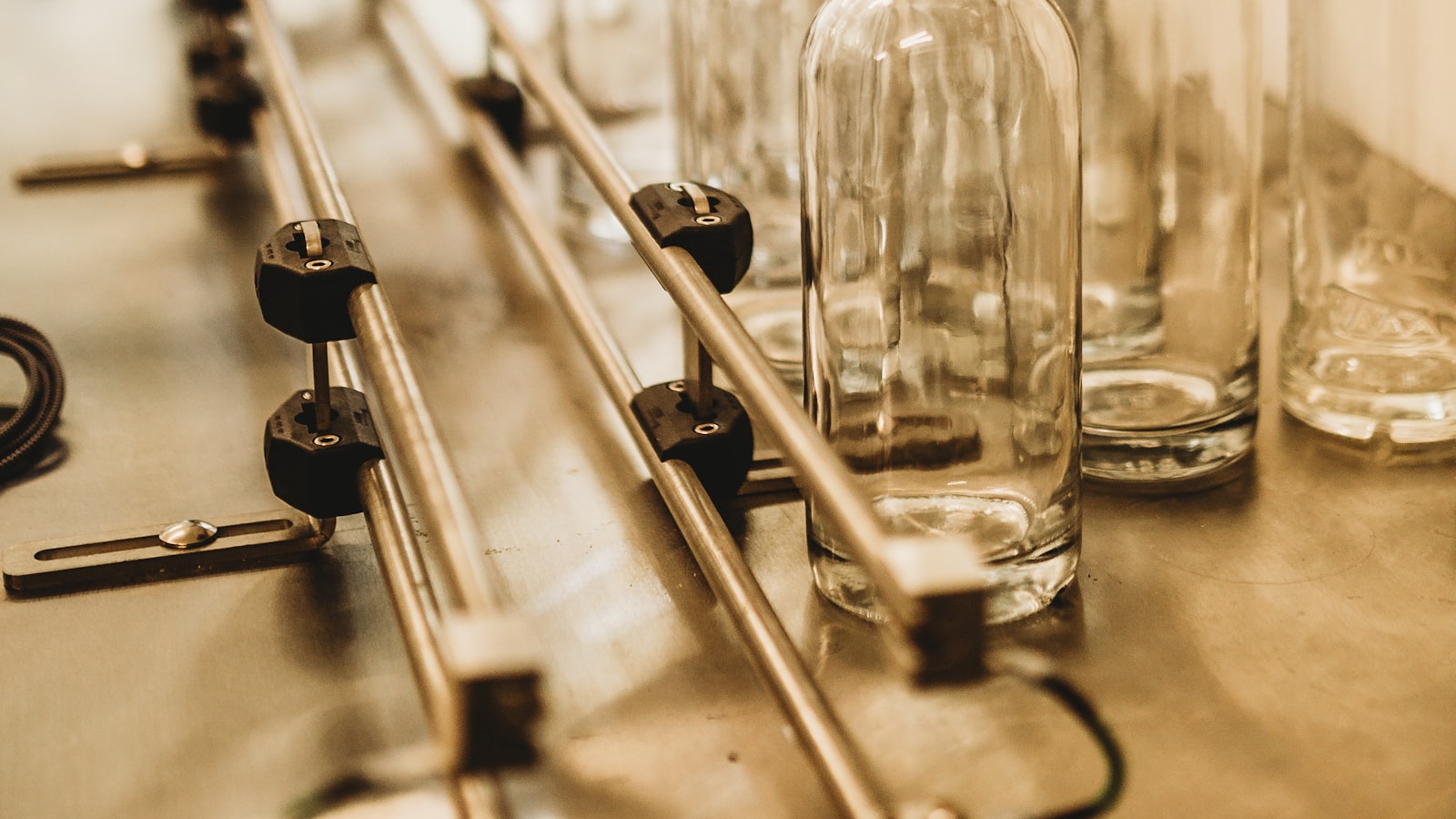 The cold end, where all 14 lines in Shandong and Xuzhou inspect a finish before anything gets packed.
Step 8. Packing and Palletising: Bulk or Pallet, Ready for the Container
Packing takes one of two forms: bulk, in layers on the container floor with pads and dividers, which fits more bottles per box; or palletised, shrink-wrapped in layers or in cartons on pallets, which unloads faster at your end. Shandong palletise automatically at the end of the line. A 40HC takes about 25,000 bottles of 750 ml (25 oz) in standard shapes, 22,000 in irregular ones, or 60,000 bottles of 12 oz (355 ml), and the loading plan for your cartons and SKU mix comes with the quotation.
What the Process Decides for Your Order
- Colour and grade are furnace decisions: your stock colours are the ones the sites melt, and anything else is a campaign with a minimum.
- The feeder and the parison set weight and wall distribution, and both follow the tolerance on your drawing.
- Annealing and the two coatings decide strength you cannot see; the polariscope report is your evidence, on request.
- Every base inspects 100 percent of finishes and verifies capacity by water-fill weight, so your capping line meets bottles that match the drawing.
- The count per container comes from shape and pack format, and your loading plan comes with the quote.