
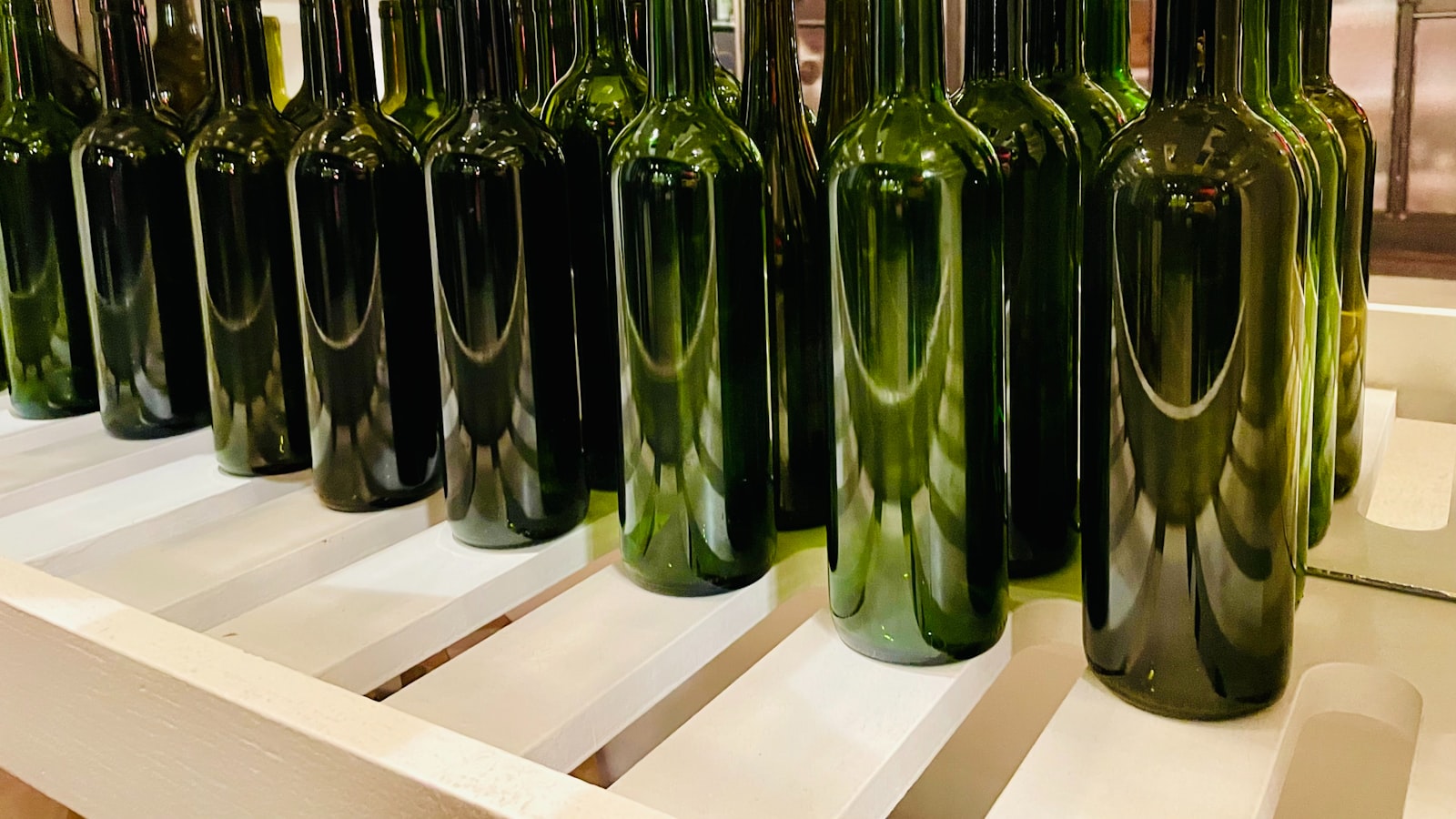
Coloured glass is not painted, tinted or coated. The colour is dissolved in the melt as metal ions, and those ions absorb particular wavelengths of light while letting the rest through. That is why your amber bottle is amber all the way through a broken edge.
What Each Metal Takes Out of Your Light
| Source | Colour you get | What it takes out of the light |
|---|---|---|
| Iron oxide | Pale green to blue-green | Some infrared and a little ultraviolet, depending on its oxidation state. |
| Chromium oxide | Strong emerald to dead-leaf green | A useful part of the ultraviolet band, and much of the red. |
| Sulphur with carbon | Amber, from pale honey to near-black | The widest ultraviolet block available in container glass. |
| Cobalt oxide | Deep blue | Yellow and orange light, which is why it reads so saturated. |
Why Iron Behaves Differently in Your Furnace
Iron is the one colourant that arrives whether you want it or not, since sand carries traces of it. What it does to your glass depends on the melting conditions rather than the amount.
In an oxidising furnace it sits mostly as ferric iron and tints the glass faintly yellow-green. In a reducing furnace the ferrous state dominates and pulls the colour toward blue-green while absorbing more heat. Two batches with identical iron content can therefore give you two visibly different bottles.
 The same batch can read differently by furnace condition. SGSBOTTLE controls colour across 14 lines.
Why Amber Behaves Like a Reaction
Amber is the odd one out. It comes from a sulphur and carbon reaction that builds an iron-sulphur complex in the melt, and that complex is an extraordinarily strong absorber in the ultraviolet.
Because it depends on a reaction rather than a dose, amber needs tight furnace control to stay consistent. A shift in oxidation moves your shade from honey toward brown or drops the protection entirely, which is why a reputable factory measures transmission rather than judging colour by eye.
What Your Glass Colour Actually Protects
Light damage is wavelength-specific. Hop compounds in beer break down under ultraviolet and blue light, some vitamins in juice degrade under near-ultraviolet, and olive oil oxidises faster under the same band that amber blocks best.
Match the glass to the risk instead of to the look. A 330 ml (11 oz) beer bottle in flint glass looks bright on a shelf and gives your product no defence at all, while the same beer in amber holds its character through a lit retail display.
Why Colour Drives Your Lead Time
A furnace melts one colour at a time and runs it for a campaign. Changing colour means draining and reconditioning, so factories schedule colours in blocks rather than on demand.
That scheduling is what a buyer feels. SGSBOTTLE runs flint, amber and green campaigns across the 14 lines in Shandong and Xuzhou, and your quotation names the campaign window along with the minimum for the colour you want. A 750 ml (25 oz) green bottle ordered inside a campaign ships far sooner than the same bottle ordered against an empty schedule.
What Goes on Your Enquiry
Your product and its light sensitivity, the format in ml and oz, the colour you have in mind, and the date you need the goods. SGSBOTTLE comes back with the colour, the transmission data behind it and the campaign window for your order.