
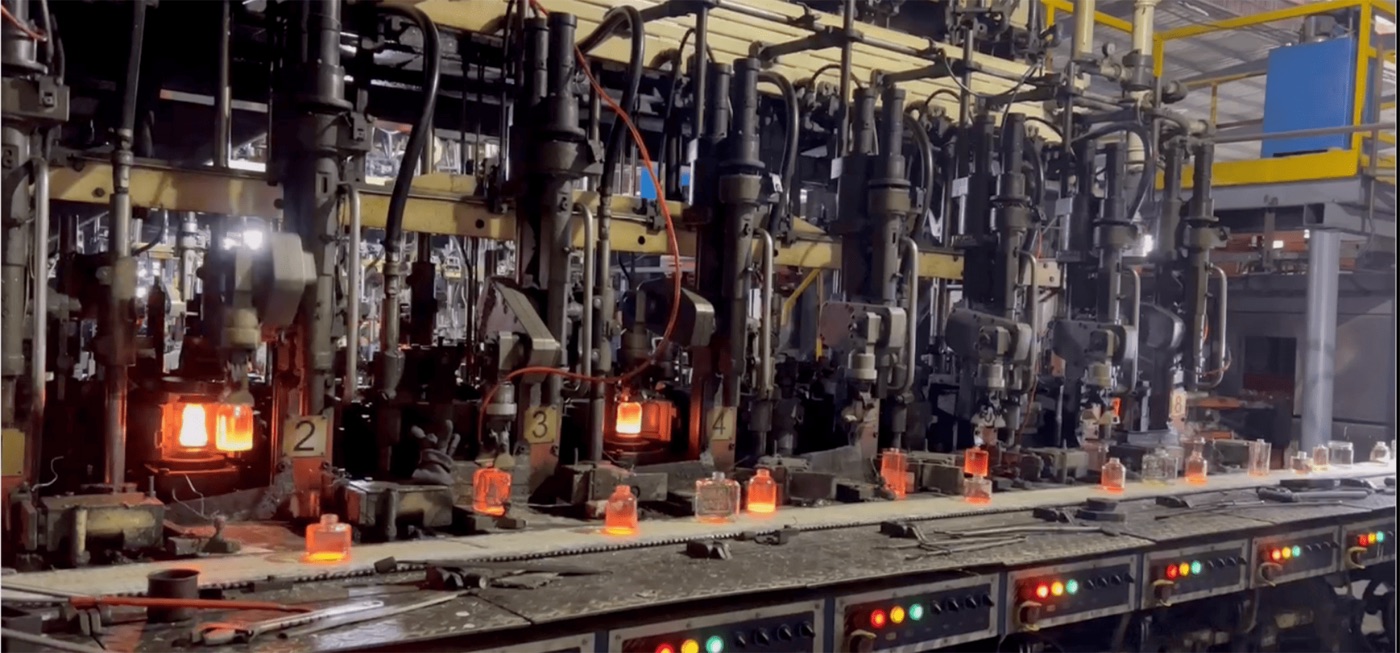
Almost every glass bottle and jar in the world comes off the same kind of machine. Knowing how it works explains your line speed, your tooling cost, your minimum, and why a supplier talks about sections instead of bottles.
What a Section Does
An IS machine is a row of identical sections sharing a gob distributor, a conveyor and a control system. Each section owns your blank mould, your blow mould, a neck ring and its own timing.
One cycle runs the same way in every section. A gob drops into the blank mould, where the neck ring forms your finish first, while the glass is still soft enough to move. The parison takes shape, transfers to the blow mould, and air blows it out to its final form. A take-out arm lifts your bottle onto the conveyor, and the moulds close again on the next gob.
Sections work independently on purpose. An operator stops one for a mould change or a repair while the rest keep forming your order, which matters when the furnace behind them never switches off.
How Output Is Actually Calculated
| Factor | What it contributes |
|---|---|
| Section count | 6, 8, 10 or 12 sections, each forming a container every cycle. |
| Gobs per section | Single, double or triple, so one section can make three at a time. |
| Cycle time | Limited by how fast the glass cools enough to hold its shape. |
| Job change time | Every format change costs production, so runs are batched. |
Multiply the first three and you have the output of one line making your 330 ml (11 oz) or 750 ml (25 oz) bottles. A plant therefore adds capacity by adding sections and cavities instead of running each section faster, because the cooling rate of glass is a physical limit nobody negotiates.
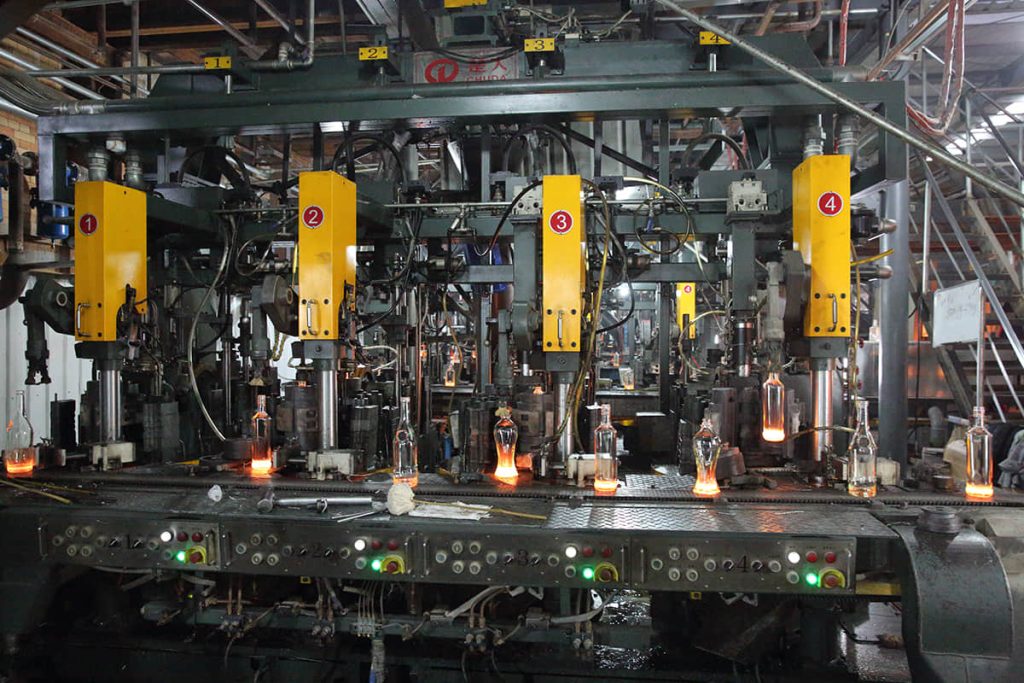 Each section is a complete bottle factory. A line is simply several of them side by side.
What This Explains About Your Quotation
Your minimum, first. A line forming thousands of containers an hour spends real money on every job change, so your run has to justify stopping and re-tooling. The 12,000-piece minimum in extra-flint and 50,000 in standard flint come from that arithmetic instead of from policy.
Then your flexibility. Some plants dedicate a line to one product for weeks, and others run several at once. The Xuzhou site in Jiangsu runs up to 8 products on a single line, which is why mixed and smaller orders are scheduled there instead of behind a container of one shape.
Where Your Quality Comes From
Three things happen inside a section that decide what you receive. The neck ring forms your finish before anything else, so finish accuracy belongs to the very start of the cycle. Cooling controls how evenly your glass distributes, which decides wall thickness and pressure resistance. And mould temperature has to stay stable, because a mould running cold prints cold-mould marks onto your bottle.
Section-to-section variation is the other reason your inspection matters. Twelve sections behave as twelve slightly different machines, so a defect on every twelfth bottle usually points at one section.
What Goes on Your Enquiry
The format in ml and oz, the annual volume, and whether your order is a single shape or a mixed set. SGSBOTTLE forms your containers on 14 lines across two sites in Shandong and Xuzhou, and our engineers come back with the base whose machines suit the run.