
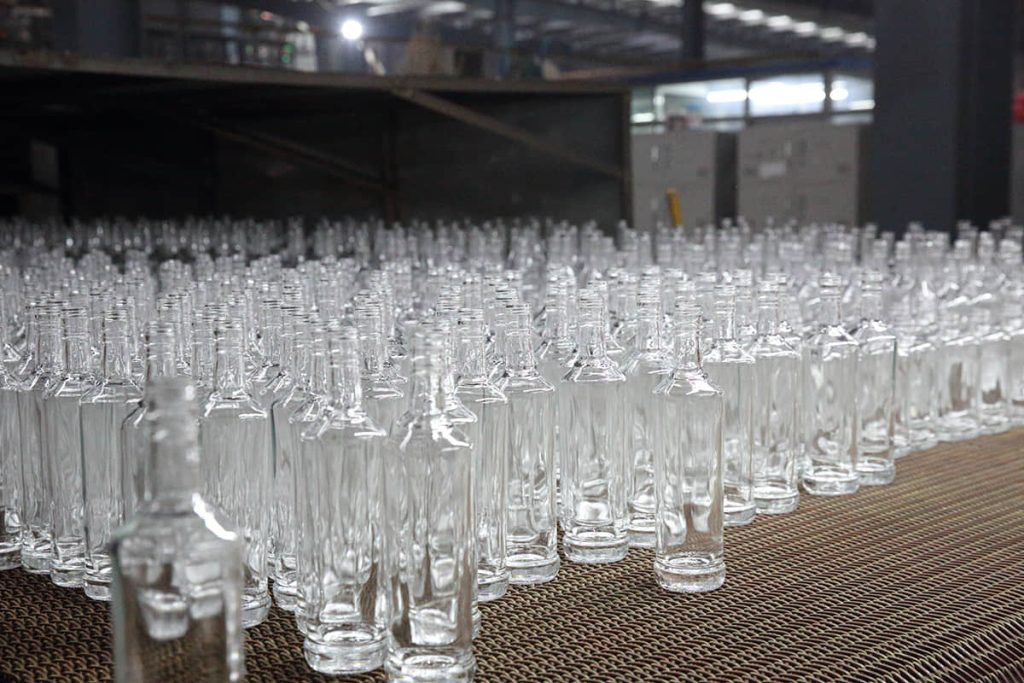
Your line speed is limited by how hard your bottles press against each other, not by how fast your filler can run. Every extra unit an hour raises that pressure, and glass keeps a record of it.
The 4 Places Your Bottles Get Hurt
| Place | What happens | What you see afterwards |
|---|---|---|
| Mass-flow conveyor | Bottles press together sideways under accumulation. | A scuff ring around the widest part of your body. |
| Star wheel and infeed | Each bottle is gripped and turned at speed. | Vertical marks near your shoulder and finish. |
| Filler and capper | Downward force and rotation on the finish. | Chipped finishes, and torque that will not settle. |
| Discharge and packing | Bottles meet dead plates, rails and each other. | Base wear, and breakage that appears after the line. |
Why Coating Buys You Speed
Your cold-end coating lowers the friction between one bottle and the next. Coated bottles slide past each other where uncoated ones grip, stall and grind.
That is why coating shows up as line speed rather than as appearance. SGSBOTTLE runs hot-end and cold-end applicators on all 14 lines in Shandong and Xuzhou, and the coating band can be matched to your labels and your washer.
What Wall Distribution Contributes
Your bottle fails at its thinnest point, so a design with even walls tolerates the knocks a line delivers. A heavier bottle with a thin shoulder does not.
That connects your line performance to your sample stage. Ask for wall readings on a sectioned sample rather than a weight alone, and a 330 ml (11 oz) bottle with a measured minimum wall gives your engineer something to plan against.
 Coating and wall data both reach your line. SGSBOTTLE gauges output at 14 lines in Shandong and Xuzhou.
Finding Your Real Speed Ceiling
Run the line up in steps and watch three signals rather than one. Scuffing on bottles taken off the discharge, jams per hour, and breakage counted rather than estimated.
Your ceiling is where any of the three starts climbing, and it usually arrives before the filler is working hard. Recording it gives you a number to defend when someone asks why the line is not running faster.
Settings That Cost You Nothing
Three adjustments buy speed without new equipment. Lower accumulation pressure, so bottles queue rather than push. Guide rails set to your actual bottle width instead of the last format.
And dead plate transitions checked for height, since a step that a plastic container rides over will chip a 750 ml (25 oz) glass base. None of those need a purchase order.
What Goes on Your Enquiry
Your line speed and conveyor type, the format in ml and oz, your closure and label, and any scuffing or breakage you already see. SGSBOTTLE comes back with the coating specification, the wall data and bottles for a line trial.