
Two bottles can be identical on every dimension and behave differently under the same knock. The difference sits inside the glass, invisible until you put the bottle between two filters and let physics show it to you.
The 3 Steps of a Polariscope Check
| Step | What happens | What you learn |
|---|---|---|
| Polarise | Light passes through the first filter in one plane. | A controlled beam, so any change comes from your glass. |
| Pass through the bottle | Stressed glass rotates the light; sound glass does not. | Where stress sits, and how much of it there is. |
| Analyse | A second crossed filter blocks unrotated light. | Coloured fringes on stress and darkness everywhere else. |
Why Colour Tells You the Amount
The rotation is not all or nothing. Stress delays one component of the light relative to another, and the size of that delay decides which colour reaches your eye.
So the fringe pattern is a scale, not a flag. A pale grey haze means light stress and strong colour means a bottle that should never leave the factory, and a technician reads that difference in seconds.
What ASTM C148 Actually Gives You
The standard turns the reading into a number. Your bottle gets compared against a calibrated reference disc, and the result is an annealing grade that your specification can name and your incoming inspection can repeat.
That repeatability is the point. SGSBOTTLE runs polariscope checks at the cold end on all 14 lines in Shandong and Xuzhou, and the grade appears on the report travelling with your 330 ml (11 oz) order.
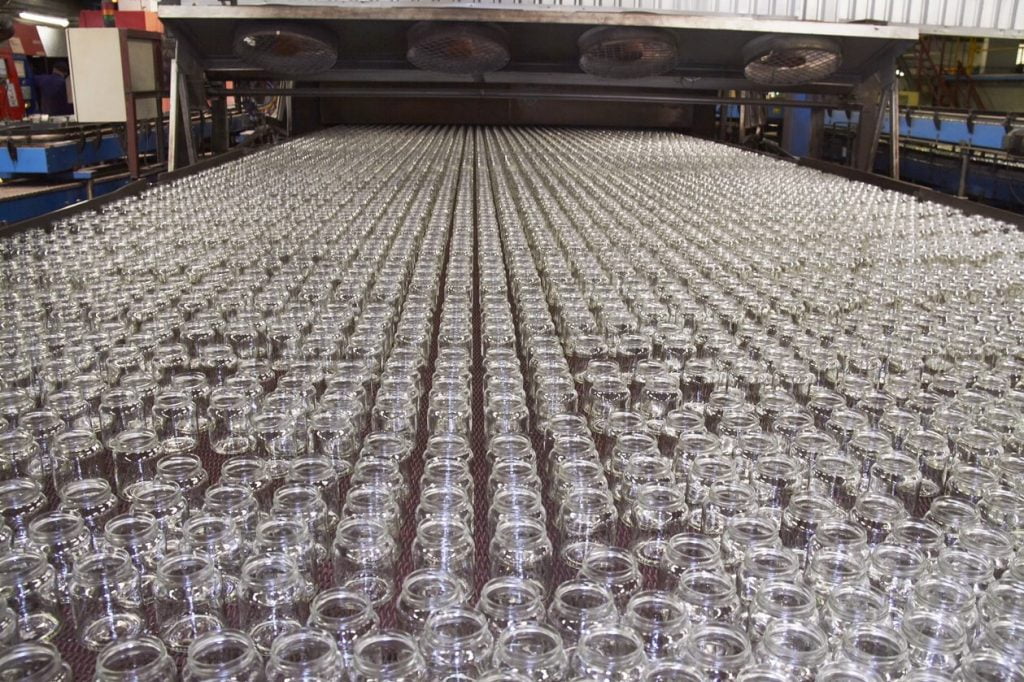 Stress shows as colour under crossed filters. SGSBOTTLE grades output from 14 lines in Shandong and Xuzhou.
Where Stress Concentrates in Your Bottle
Look at the heel and the base first. Those areas cool last and carry the sharpest change of section, so residual stress gathers there more often than anywhere else.
The shoulder comes second, and the area around any inclusion comes third. A stone or a bubble creates local stress because it expands at a different rate from the glass around it, which is why a polariscope also flags inclusions your eye would pass over.
What to Ask For and What to Do With It
Ask for the annealing grade on samples from your own production run, not from stock. Then add the grade to your specification so a future order has the same requirement.
If your product meets thermal shock at any point, ask for that result too. A 750 ml (25 oz) bottle that is hot filled, pasteurised or washed hot uses part of its strength absorbing the gradient, and residual stress spends the rest.
What Goes on Your Enquiry
Your format in ml and oz, the fill and its temperature, whether the bottle is pasteurised or washed, and your storage conditions. SGSBOTTLE quality engineers in Shandong come back with the annealing grade and the supporting test results for your order.