
An AQL is the line between a lot you accept and a lot you send back, and it only works when you, your inspector and the factory read the same defect list. Three things follow: the defect classes as glass factories classify them, the sampling maths behind an acceptance number, and what SGSBOTTLE's 14 lines in Shandong and Xuzhou check on 100 percent of bottles before the sampling starts. With them in hand, the AQL in your order means the same thing on both sides of the ocean.
What an AQL Actually Promises You
AQL stands for acceptable quality limit: the worst process average, as a percentage of defective pieces, that a sampling plan will still accept most of the time. It is a statistical statement about the lot and never a guarantee about every bottle. An AQL of 1.0 for majors means a lot running at 1 percent majors passes most of the time; it does not mean your container carries exactly 1 percent. The plan pulls a random sample, counts defects by class, and accepts or rejects the whole lot on an acceptance number. Three things therefore go into your order: the defect list by class, the AQL for each class, and the inspection level that sets the sample size.
The 3 Defect Classes on a Glass Bottle
Glass factories classify a defect by what it does to the bottle in use. Most buyers specify critical at zero, major at 1.0 and minor at 2.5, and any tighter set goes into your order and your inspector's brief.
| Class | What it means | Typical defects | What it costs you |
|---|---|---|---|
| Critical | The bottle is unsafe or unusable: it can injure, leak or fail on the line. | Checks and cracks anywhere. A chipped or sunken sealing surface. Stones or blisters in the sidewall. Spikes, bird swings or glass threads inside the bottle. A broken or missing finish, or loose glass in the container. | One critical in the sample rejects the lot, because a single one can reach your consumer. |
| Major | The bottle is unfit for its purpose or will fail on your line. | A finish out of tolerance, so your cap leaks or cross-threads. Capacity or fill point out of tolerance. Thin spots in the wall distribution. A leaning or oval neck, or sharp and offset mould seams. Heavy cords or blisters in your print panel. Residual stress on the polariscope. | Counted against the acceptance number; a lot over the AQL costs you a re-sort at the factory or a replacement run. |
| Minor | Cosmetic: the bottle works but looks wrong. | Seeds within the standard; faint cords; light mould marks; small surface scratches; slight shade variation in a coated colour; a dirty bottle. | Counted against a looser AQL; a lot over it is a negotiation on price or re-sort and never a safety question. |
Most orders leave the list to the factory. It is the part to write down, because a blister in a print panel is a major to a spirits brand and a minor to a jam packer. Your defect list can be ours, yours, or ours with your additions, and it goes into the order with the AQL.
Sampling Under ISO 2859-1: Lot Size, Sample Size and Acceptance Number
Sample sizes come from ISO 2859-1, published in North America as ANSI/ASQ Z1.4, at General Inspection Level II, the level almost every glass order uses. The single-sampling normal plan for the lot sizes a container order falls into reads as follows.
| Lot size | Sample size | Accept / reject at AQL 1.0 | Accept / reject at AQL 2.5 |
|---|---|---|---|
| 3,201 to 10,000 | 200 | 5 / 6 | 10 / 11 |
| 10,001 to 35,000 | 315 | 7 / 8 | 14 / 15 |
| 35,001 to 150,000 | 500 | 10 / 11 | 21 / 22 |
| 150,001 to 500,000 | 800 | 14 / 15 | 21 / 22 |
A 40HC of 25,000 spirits bottles from Shandong falls in the 10,001 to 35,000 band. Your inspector pulls 315 bottles at random from across the pallets. The lot passes on majors with 7 defective bottles or fewer and fails on 8, and it passes on minors up to 14. Criticals sit at zero in nearly every order, so one critical in the 315 rejects the lot outright. Tightening majors to 0.65 keeps the sample at 315 and drops the acceptance number to 5. That is the whole cost of a tighter AQL: the same sample, a harder pass.
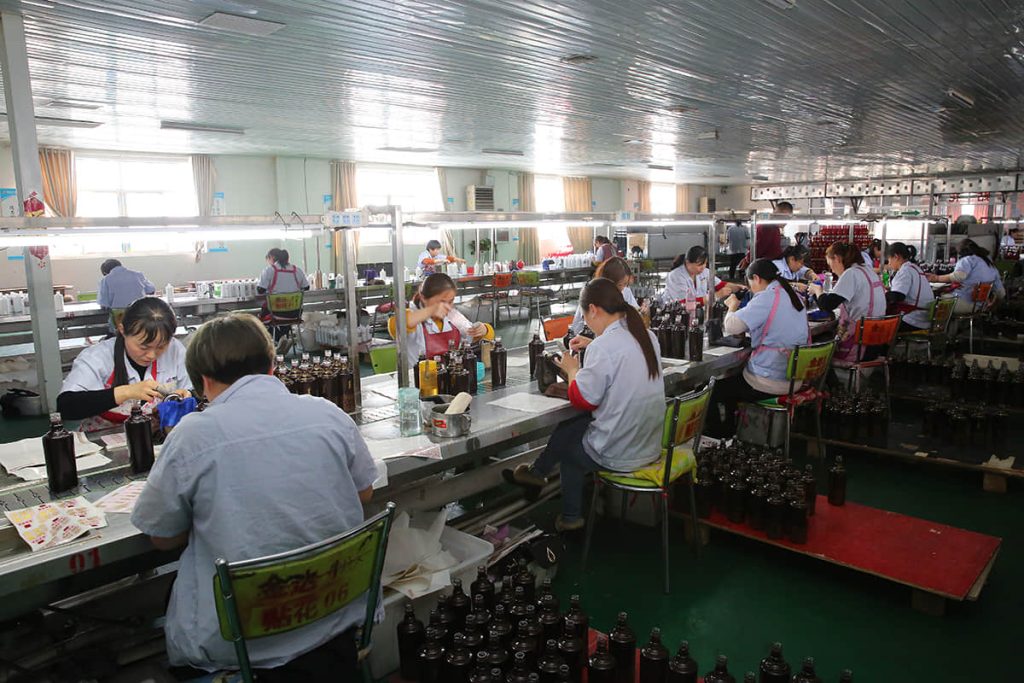 Shandong checks by machine and by hand, and Xuzhou inspects 100 percent of finishes by hand, with a random check twelve times a day.
What SGSBOTTLE Checks on 100 Percent of Bottles Before Your Sample Starts
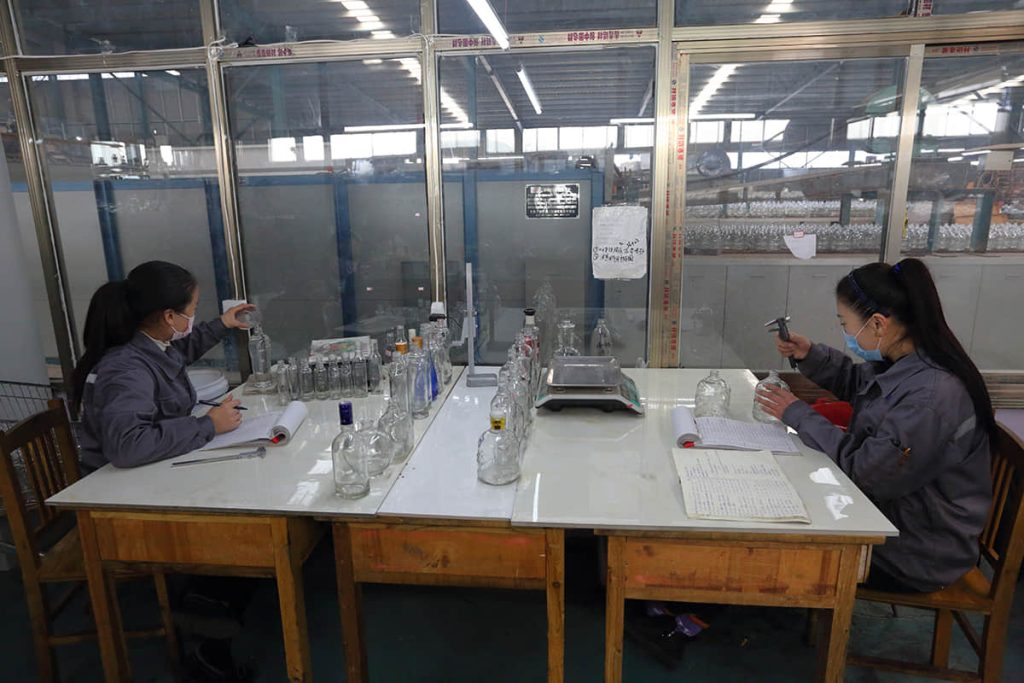
An AQL sample is your check on the packed lot. It comes after the factory's own inspection, and the two do different jobs: yours proves the lot, ours removes the defects before there is a lot to prove. At both SGSBOTTLE sites, an inspector or a machine checks the finish and sealing surface of every bottle before packing. A chip on a sealing surface is a leak on your customer's shelf. Shandong runs automatic inspection machines on its lines and inspectors check behind them; Xuzhou inspects 100 percent of pieces by hand, with a random check every two hours, twelve times a day. Both sites verify capacity by water-fill weight as routine, every line runs a polariscope check for residual stress, and the written polariscope report joins your shipment on request.
Two coatings in Shandong protect what the inspection passed: a hot-end tin-oxide film that closes surface micro-cracks, and a cold-end lubricant that stops bottles scratching each other on the conveyor, so the strength the inspector measured is the strength that reaches your filler.
The Outgoing Plan a Glass Plant Runs, and What the Trade Uses
Your AQL and the plant's outgoing AQL are two plans, and both follow the same standard. Glass plants run lot-based final inspection to ISO 2859-1, or its North American twin ANSI/ASQ Z1.4, at General Inspection Level II under normal severity, which is the level the moulded-glass trade treats as its default. The class figures the trade works to sit in a narrow band: zero for criticals, between 0.4 and 1.0 for majors, and 2.5 or looser for minors, tightened for pharmaceutical and premium spirits work and relaxed for cosmetic-only classes.
The industry works to those figures, and they hold only as far as your order repeats them. The AQL that governs your container is the one written into your purchase order and your inspector's brief, so a figure you care about goes in there rather than staying an assumption. Severity moves too: ISO 2859-1 switches a supplier to tightened inspection after repeated rejections and back to normal once the process settles, and naming that switching rule in the order is what makes an AQL a control rather than a number.
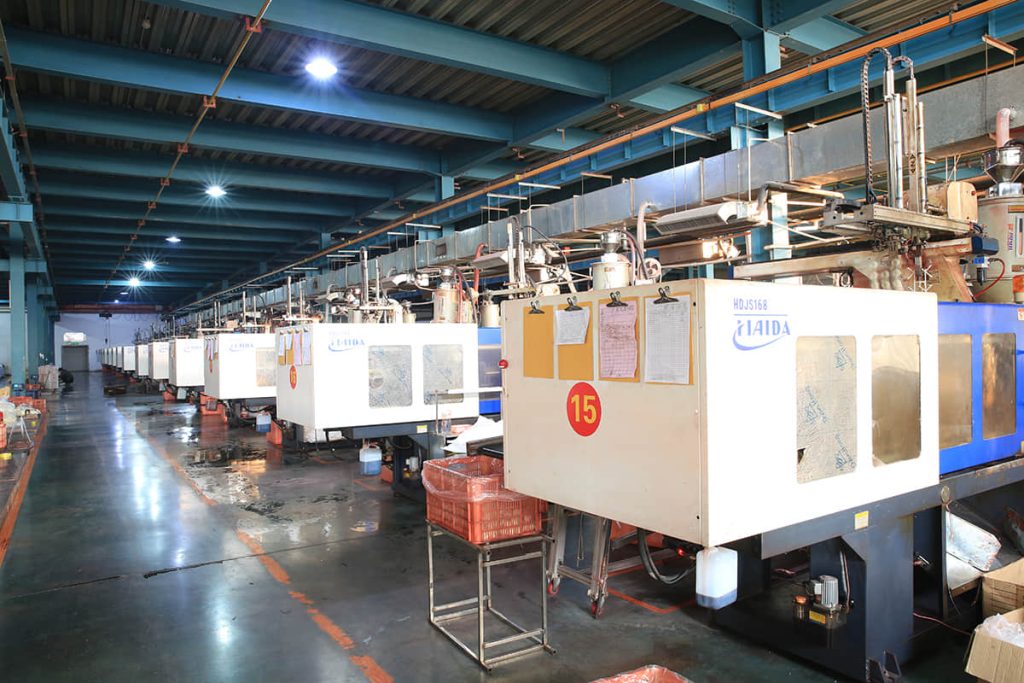 Your AQL sample gets drawn after this, and proves the lot the plant has already inspected.
What a Pre-Shipment Inspection Report Carries
A third-party pre-shipment inspection, by SGS, TÜV, Bureau Veritas or your own inspector, happens at the factory before loading and against the plan in your order. You hold the report before the container leaves Shandong. It carries the purchase order and lot reference, the sample size and the plan it follows, and every defect found by class, with photographs. It carries the measurements taken against your drawing: capacity, weight, height, finish T and E. It carries a check of packing, marking and carton count, and, when you book it, supervision of the loading itself. A report with a verdict and no measurements is a report you send back for completion.
What Goes Into Your Order
Six items settle the inspection before the first bottle forms. The defect list by class, ours or yours. The AQL for each class. The inspection level, and whether sampling is normal or tightened. Who inspects, when, and against which drawing. The disposition of a rejected lot: re-sort at the factory, replacement run or credit. And whether a polariscope report and a certificate of analysis travel with your shipment. With those written down, the AQL in your order is a number two engineers can argue about with the same table in front of them.