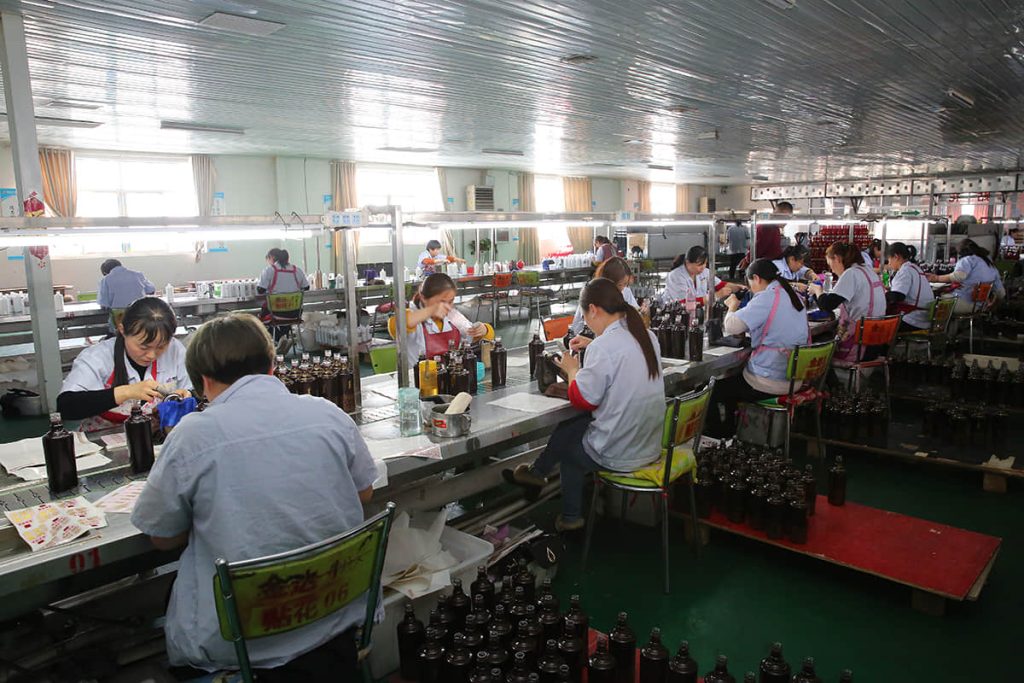
How each site inspects every glass bottle, what the six transit failure modes look like, and which certificate answers which customs or retailer request.
Most plants sample. SGSBOTTLE inspects the finish and sealing surface of every glass bottle, at all two sites. Shandong does it by automatic inspection machine, with an inspector checking behind it. Xuzhou does it by hand on 100 percent of pieces, with a random check every two hours, twelve times a day.
Capacity gets verified by water-fill weight as routine, and all 14 lines in Shandong and Xuzhou run a polariscope strain check. Your batch gets the written strain report on request. SGSBOTTLE keeps the ISO 9001, SGS, EC 1935/2004, California Proposition 65, RoHS and CNAS documents on file in Shandong, so they go out with your quotation the day your broker asks.
Your specification decides which of these you actually receive. Name your AQL and inspection level, your annealing grade, the tests your fill needs and the market your documents must satisfy, and your order carries the evidence rather than an assurance. A 500 ml (17 oz) jar and a 1 L (34 oz) bottle are documented the same way, from the same 2 sites in Shandong and Xuzhou, so your quality file reads the same whichever format you buy. Tell us your fill, your closure and your format in ml and oz, and your report list comes with the quotation rather than after your first complaint.

Internal pressure to ISO 7458, thermal shock to ISO 7459 and vertical load to ISO 8113: the methods, the figures the trade quotes, and how to write one into your order.
Critical, major and minor glass bottle defects, the AQL most buyers write into an order, the ISO 2859-1 sample sizes behind it, and what SGSBOTTLE checks before packing.
ISO 9001, the SGS FDA lead and cadmium report, EC 1935/2004, Proposition 65, RoHS and a CNAS report: what each glass packaging certificate covers, and what it does not.
A bottle that cools too fast breaks for no visible reason. What your annealing lehr does, how residual stress is graded in polarised light, and what to ask a supplier.
A polariscope turns invisible stress into colour. How the instrument works, what an annealing grade under ASTM C148 means, and how to read the number on your report.
Glass breaks from a temperature difference across its wall, not from heat itself. Where your process creates that gradient, how the test runs, and how to design it out.
Carbonated fills push outward for the life of the pack. How the two ISO 7458 methods differ, what a burst figure tells you, and how to specify pressure resistance.
A bottle at the base of a pallet carries the whole stack. How ISO 8113 measures vertical load, where the force actually goes, and what your stacking plan implies.
An AQL is only half a sampling plan. What inspection levels I, II and III change, how normal, tightened and reduced inspection switch, and what to write into your order.
An inspection agency verifies what a factory reports. What SGS, TUV and Bureau Veritas actually do on a glass order, what they cannot cover, and how to brief one.
A factory tour shows you what the host chooses. What to ask about furnaces, forming, the cold end, tooling and records, and which answers tell you the most.
Glass is inert, and buyers still need paperwork. What lead and cadmium testing covers, what an EC 1935/2004 declaration says, and which document each market wants.
Glass is inert and US paperwork still exists. What FDA food contact, Proposition 65, net quantity labelling, TTB fill standards and state deposit laws each ask of you.
The EU regulates the material, the quantity and the waste. What EC 1935/2004, nominal quantities, the e-mark, packaging waste rules and EPR each ask of a glass buyer.
UK rules started from EU law and have moved. What assimilated food-contact law, packaging EPR reporting, deposit schemes and weights legislation now ask of a glass buyer.
Canada regulates labelling more tightly than the material. What bilingual labelling, metric net quantity, food-contact review and provincial stewardship each require.
Australia runs food standards, trade measurement, a recycling label and state deposit schemes at once. What each asks of your glass, and where they hit your label panel.
Japan regulates hygiene, measurement and recycling separately, and expects precision in all three. What the Food Sanitation Act and labelling ask of your glass.
Mexico works through NOM standards, and front-of-pack warnings changed label design there. What NOM labelling, net content and alcohol rules do to your panel.
Brazil splits packaging oversight between health, metrology and waste policy, with MERCOSUR behind it. What ANVISA, INMETRO and reverse logistics each ask of your glass.
Collected glass and furnace-ready cullet are not the same thing. What happens between the bin and the batch, and why colour sorting decides the outcome.
A recycled content figure on your pack is a public claim. What pre and post-consumer mean, how mass balance works, and what evidence a regulator expects.
A deposit scheme turns your bottle into a returnable asset. What marking, standardisation, refill weight and recognition each demand, and what to fix before tooling.
Extended producer responsibility charges you by weight, every year you sell. Who the obligated party is, how fees are modulated, and what your reporting rests on.
Melting, chemistry and freight each contribute. Where the carbon in a glass bottle actually comes from, what cullet and fuel change, and which lever is yours.
Two life cycle assessments of the same bottle can disagree completely. What scope, functional unit, trips, allocation and sponsorship each do to a result you are shown.
Yes. SGS tested our glass jars for US FDA CPG leachable lead and cadmium with a pass result, and an EC 1935/2004 declaration covers food contact in the EU. California Proposition 65, RoHS and a CNAS-accredited laboratory report are on file as well, and any of them goes out with your quotation on request.
Yes. SGS, TÜV or Bureau Veritas can inspect at the factory before loading at your request; the sample plan and the AQL you specify go into the order, and you hold the inspection report before the container leaves Shandong.
Tell us the fill and the market and a sales engineer replies within one business day, with the finish drawing and the loading plan.
Request a Quotesales@sgsbottle.com · Mon–Sat 8:30–18:00 (GMT+8)