
Two ways exist to turn a lump of molten glass into a hollow container, and both start the same way: with a gob dropped into a mould. What happens in the next second is what separates them, and it decides your bottle's weight, its wall distribution and what shapes are open to you.
The 4 Steps of Your Blow-and-Blow Cycle
| Step | What happens | What it fixes |
|---|---|---|
| Settle blow | Air pushes the gob down into the blank mould and against the neck ring. | Your finish, formed first and formed completely. |
| Counter blow | Air enters through the finish and inflates the gob into a hollow parison. | The rough distribution of glass along your bottle. |
| Transfer and reheat | The parison inverts into the blow mould and its surface reheats from the core. | Even temperature, so the final blow stretches your glass smoothly. |
| Final blow | Air expands the parison against the blow mould. | Your shape, your embossing and your final wall thickness. |
Why Your Finish Is Formed First
Glass cools from the outside, so the thinnest and most accurate feature has to be made while the material is at its softest. In blow-and-blow the settle blow presses glass into the neck ring at the very start of the cycle, before anything else takes shape.
That order explains something buyers notice: finish accuracy holds even on complex bottles, because the finish never waits for the body. It is also why the neck ring is a separate piece of tooling in your mould set, changed and maintained on its own schedule.
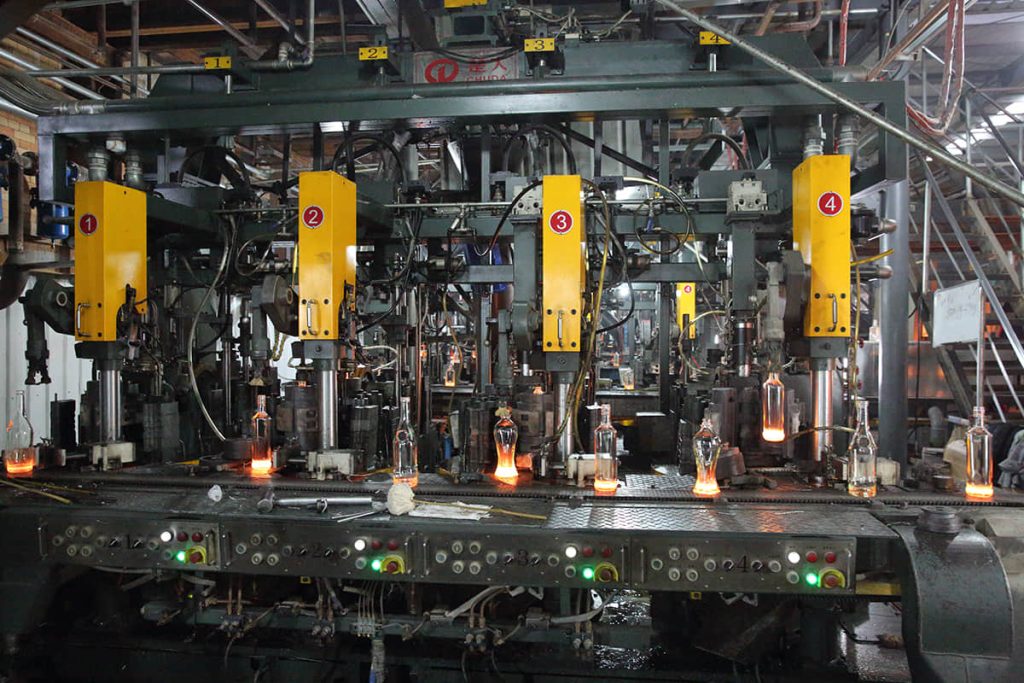 Two blows in the blank mould, one in the blow mould. Your finish is complete before the body exists.
Where Blow-and-Blow Still Wins
Three situations keep it in daily use across the industry. Heavy bottles, where the glass weight your brand wants is more than a plunger process handles comfortably. Complex silhouettes with deep punts, sharp shoulders and asymmetric bodies, which need the gentler distribution air gives. And small or specialist runs, where the tooling is simpler and a job change costs less.
Your spirits, wine and speciality bottles mostly come from it for those reasons. SGSBOTTLE forms super flint spirits glass on IS, 6S and 8S machines in Shandong, on 7 lines, and blow-and-blow is the process behind most of that range.
What It Costs You Against NNPB
Weight, mainly. Air distributes glass less evenly than a plunger, so a blow-and-blow bottle carries more glass for the same strength. On a lightweight 330 ml (11 oz) beverage bottle running at volume, that difference is worth real money in freight, which is why NNPB took over that end of the market.
The trade is worth stating plainly. Where your bottle is heavy by design, the weight penalty is invisible. Where your bottle is light and your volumes are large, it is the whole argument.
Drawing Notes When Your Bottle Is Blow-and-Blow
Two things follow. Wall distribution is less uniform than a plunger process gives, so your pressure and impact figures come from a test on the design instead of from an assumption. And the process suits shapes that would defeat NNPB, so a distinctive silhouette is not automatically a problem for your project.
The right question at drawing stage is what your bottle has to do rather than which process makes it. SGSBOTTLE engineers choose the process from the shape, the weight and the volume, and your quotation names which of the 14 lines in Shandong and Xuzhou runs it.
What Goes on Your Enquiry
The shape or a reference bottle, the weight if you have a target, the format in ml and oz, and your annual volume. SGSBOTTLE comes back with the process and the base that suit the design, and the weight each route produces.