
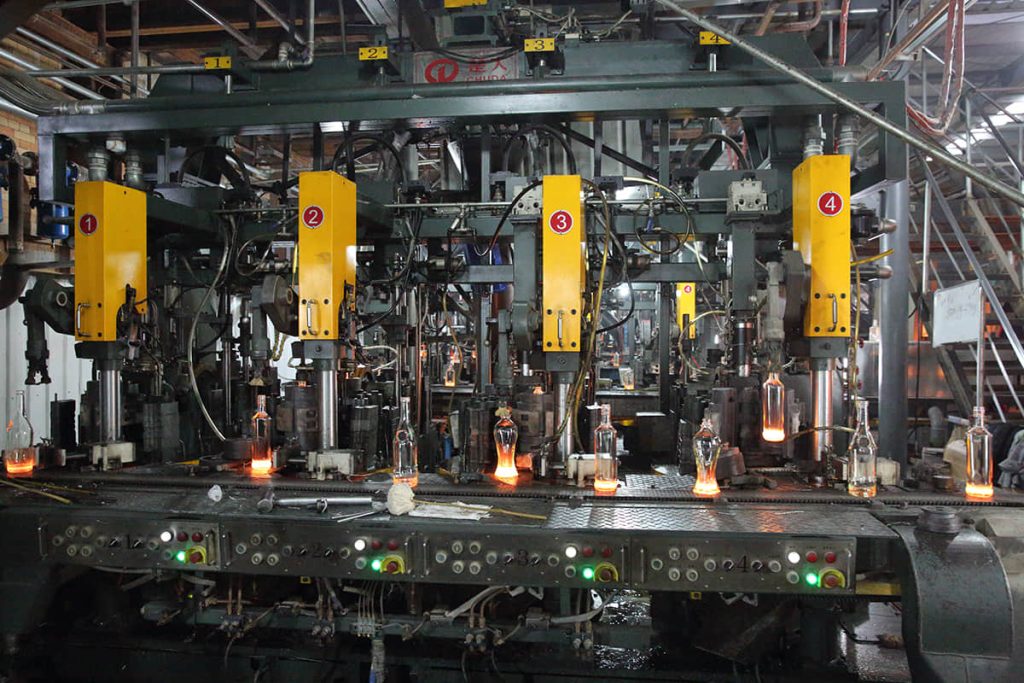
Borosilicate has a reputation that runs ahead of its use. It suits a laboratory flask and it suits your beverage line poorly, and the reason is neither strength nor quality.
The 4 Differences Between Soda-Lime and Borosilicate
| Soda-lime | Borosilicate | |
|---|---|---|
| Composition | Silica, soda ash, limestone, with cullet. | Silica with boron oxide replacing much of the alkali. |
| Thermal expansion | Higher, so a large temperature jump stresses it more. | Roughly a third as much, so it tolerates a bigger jump. |
| Melting and forming | Melts lower and forms fast on IS machines at container speed. | Melts hotter, forms slower, and costs more per piece. |
| Where it belongs | Bottles and jars for food, drink, beauty and home. | Laboratory ware, cookware, and speciality containers. |
What Thermal Expansion Changes for Your Container
Your glass breaks under thermal shock because its outside and inside change temperature at different rates, and the mismatch pulls the material apart. Lower expansion means less mismatch for the same jump, so borosilicate survives a bigger difference than your soda-lime bottle.
That advantage is real in a lab, where a flask goes from a burner to a bench. In your packaging the temperature difference is bounded: a hot fill, a pasteurisation tunnel, a dishwasher or a fridge. A well-annealed soda-lime bottle handles all of them, and the figure your specification names, usually 42 °C, is measured on your design to ISO 7459.
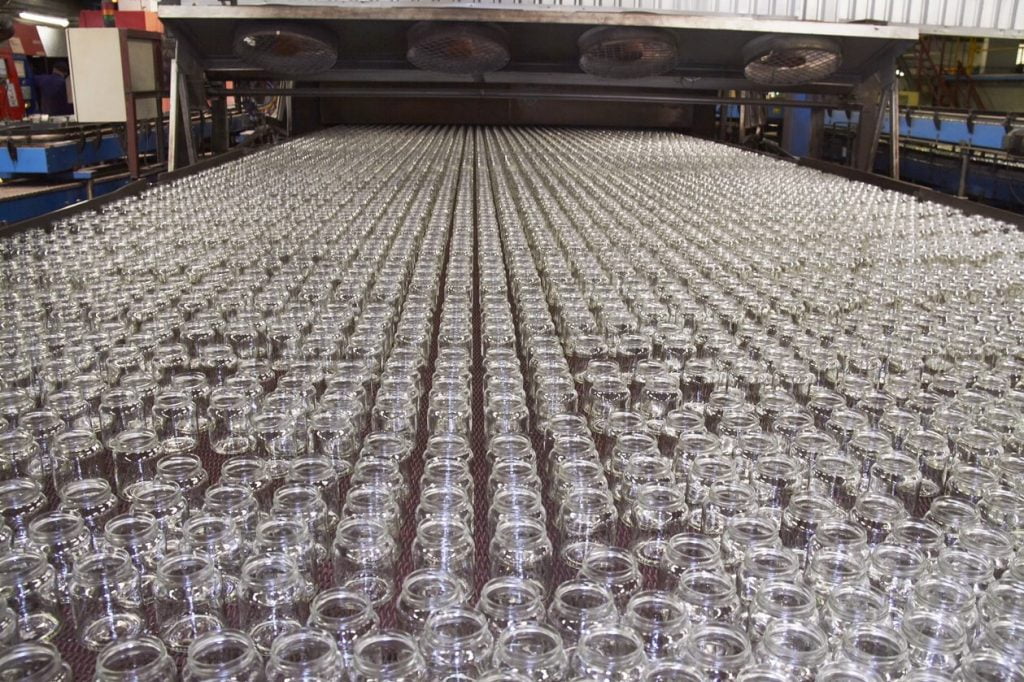 Annealing, not composition, is what decides whether your soda-lime bottle survives a temperature swing.
Why Container Glass Is Soda-Lime
Cost and speed, mostly. Soda-lime melts at a lower temperature, which matters when a furnace runs for years without stopping, and it forms at the pace an IS machine works. Borosilicate needs more energy per tonne and forms more slowly, so your borosilicate bottle costs a multiple of the soda-lime one before anything else is decided. SGSBOTTLE melts soda-lime at two sites across Shandong and Xuzhou, on 14 lines.
A recycling reason follows. Container glass is collected and remelted as one stream, and borosilicate contaminates it by melting differently. Cullet at 20 to 30 percent of the batch is normal in the container glass you buy, and keeping that stream clean is part of why the industry stays on one composition.
Where the Borosilicate Claim Gets Oversold
Two claims travel with borosilicate and neither holds for your packaging. That it is stronger, which confuses thermal performance with mechanical strength, when your impact and pressure resistance come from wall thickness and glass distribution. And that it is purer or safer, when the soda-lime container glass you buy is inert, carries the same food-contact declarations and leaches essentially nothing.
The SGSBOTTLE range is soda-lime throughout, and borosilicate appears on a handful of designs where a customer specified it. Every product page names the material per model, so nothing is left for you to assume.
When Borosilicate Is Worth Your Question
Three situations are worth your question. A product that goes from freezer to oven or takes a direct flame. A container you refill with boiling water many times a day. And a laboratory or technical application outside food and drink entirely.
Everything else you are likely to do, including hot filling, pasteurisation, dishwashers and normal cold chain, is soda-lime territory. Three variables decide it: annealing, wall distribution and the temperature difference your own process creates. A 250 ml (8 oz) jar and a 1 L (34 oz) jar behave differently under the same jump.
What Goes on Your Enquiry
The process your container meets, with its temperatures, the format in ml and oz, and how many cycles it sees. SGSBOTTLE engineers come back with the designs that suit those temperatures and the thermal shock figure the design is tested to.