
Your bottles will spend their working life touching each other. On a conveyor, in a filler, on a pallet and in a crate, glass meets glass thousands of times, and every one of those contacts is a chance to lose strength you already paid for.
Why a Single Scratch Matters So Much
Glass carries load beautifully until a surface flaw gives the stress somewhere to concentrate. A scratch does exactly that, and the material has no mechanism to repair it.
The loss is permanent. Your bottle keeps its weight, its wall thickness and its appearance, but the pressure it survives and the impact it takes both drop, and nothing later in the process gives that back.
What the Cold End Adds
After the annealing lehr, applicators lay a lubricity coating onto your cooled bottles. Polyethylene and oleic-acid based chemistries are the common ones, and both do the same job: they lower the friction between one bottle and the next.
The change is easy to see on a line. Uncoated bottles grip each other and stall in a mass-flow conveyor; coated bottles slide, and your line speed goes up while the scuffing goes down. SGSBOTTLE runs cold-end applicators after every lehr across the 14 lines in Shandong and Xuzhou.
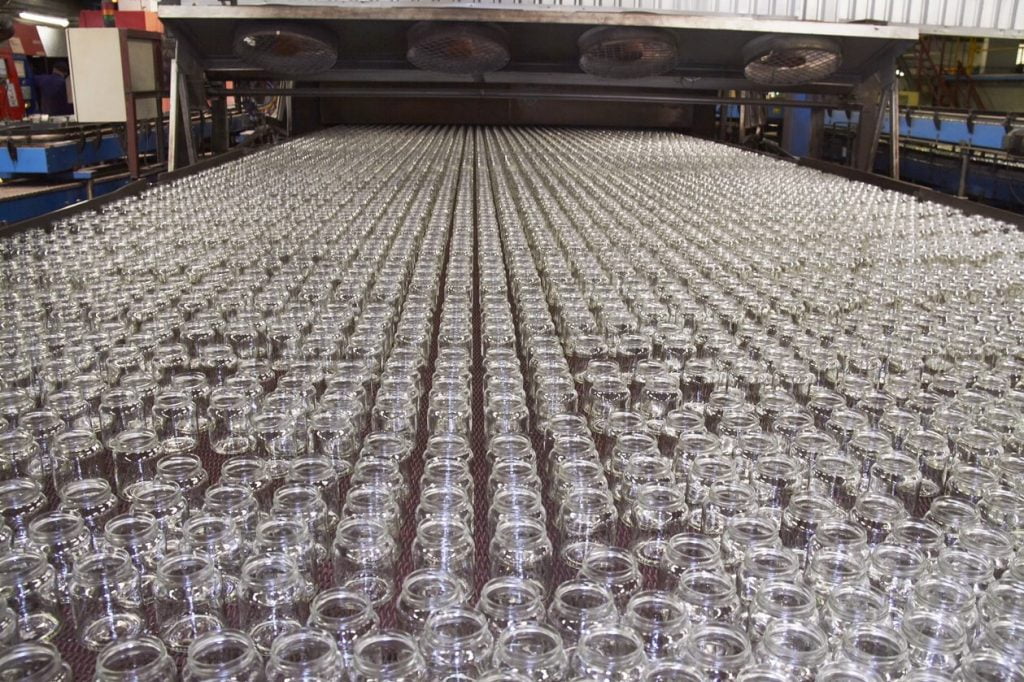 Coated bottles slide instead of scrape. SGSBOTTLE checks lubricity on all 14 lines before packing.
The 3 Places Your Bottles Get Damaged
| Where | What happens | What you see later |
|---|---|---|
| Mass-flow conveyor | Bottles press together sideways at speed. | A scuff ring around the widest part of your body. |
| Filler and capper | Star wheels and guides hold each bottle firmly. | Vertical marks near the shoulder and finish. |
| Pallet and transit | Vibration rubs neighbours together for days. | Dull patches where bottles touched, and higher breakage on arrival. |
How Lubricity Is Tested
A tilt table gives the working answer. Two bottles are laid together on a plate that tilts until one slides across the other, and the angle at that moment converts to a coefficient of friction.
Lower is better, within limits. A 500 ml (17 oz) bottle that slides too freely can walk on a pallet, so factories aim for a band rather than a minimum, and the test result belongs in the report that travels with your shipment.
Where It Fights Your Label
Labels want grip and the cold end delivers slip, so the two goals pull against each other. Pressure-sensitive labels are the most sensitive, and a corner that lifts in a humid container is often a coating question rather than an adhesive fault.
Tell your supplier what you are applying before the run. Wet glue, pressure-sensitive film, shrink sleeve and direct printing each want a different coating band, and a 330 ml (11 oz) bottle labelled with the wrong band costs you a rework you cannot do at the port.
What Goes on Your Enquiry
Your format in ml and oz, the label or sleeve type, whether the bottles are returned and washed, and your conveyor and filling speed. SGSBOTTLE quality engineers in Shandong come back with the coating band and the friction figures for your order.